
In EU5, values are what define your nation, it’s people and society. Is yours a humanistic, tolerant society, or a spiritualistic slave to the Papacy? Is your peasantry free to live and work where they will, or do they know their place? Centralized, conciliatory and plutocratic or decentralized, belligerent and aristocratic?
Values in EU5 are both shaped by your actions and choices and guide them. A heavily Plutocratic nation will have a more powerful Burghers estate, and having more powerful Burghers will push you towards Plutocratic.
Your values are only indirectly under your control. Like many things in EU5, values interact and trade off with other mechanics such as estate privileges. Depending on what nation you’re playing and your objectives you will want to have a long-term strategy for which values you want and how to get there.
| Written | December 2025 |
| Up to date for | 1.0.10 |
| Scrub level | 1/3 (noob) |
The Values UI
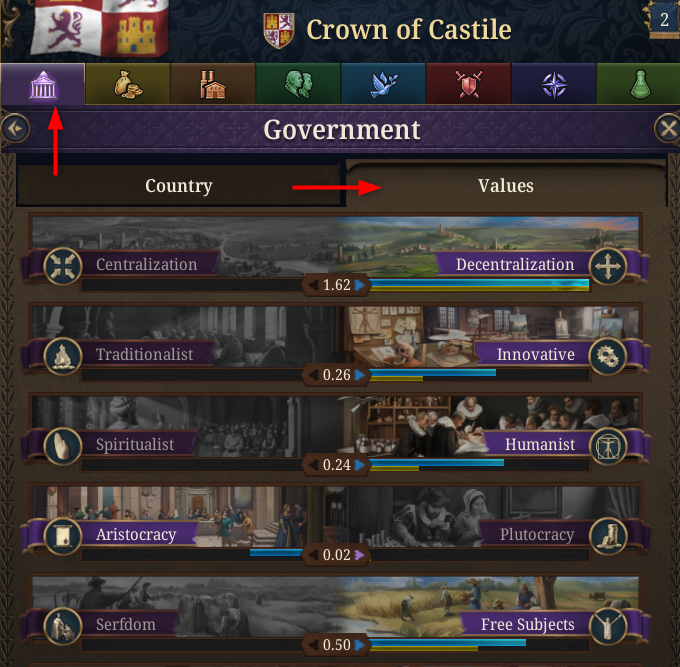
Values can be accessed under the Government tab (F1) and then Values.
For each value, you can see the current trend as a blue line and the total monthly progress as a number in the center. Mouse over that number to see a breakdown:
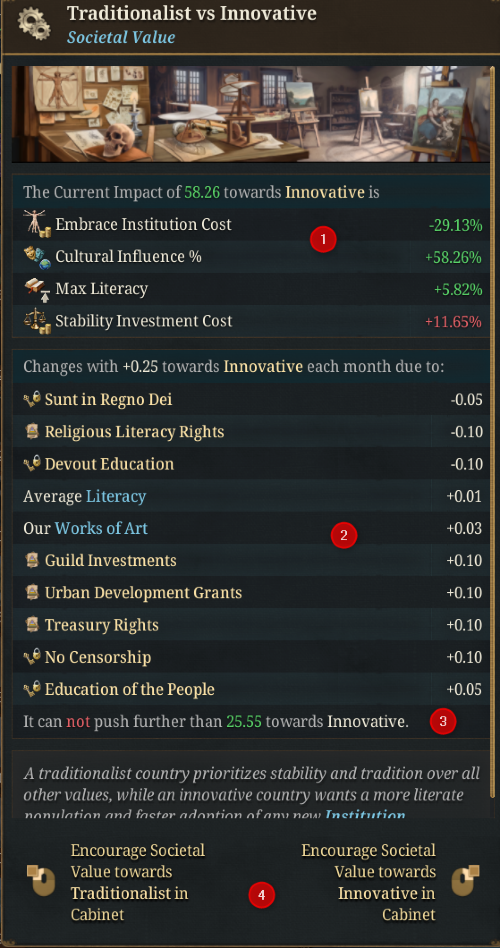
The top section (1) shows you the current progress (58.26 in this case) and the modifiers it provides.
The second section (2) shows you the monthly progress (0.25), as well as which privileges, laws, and modifiers add up to that number. Below that (3) is telling you the limit to which it can push by itself (25.55 for Innovative).
Finally, at the bottom (4) you have shortcuts to have one of your Cabinet members push in one direction or another.
You can also mouse over one of the values themselves:
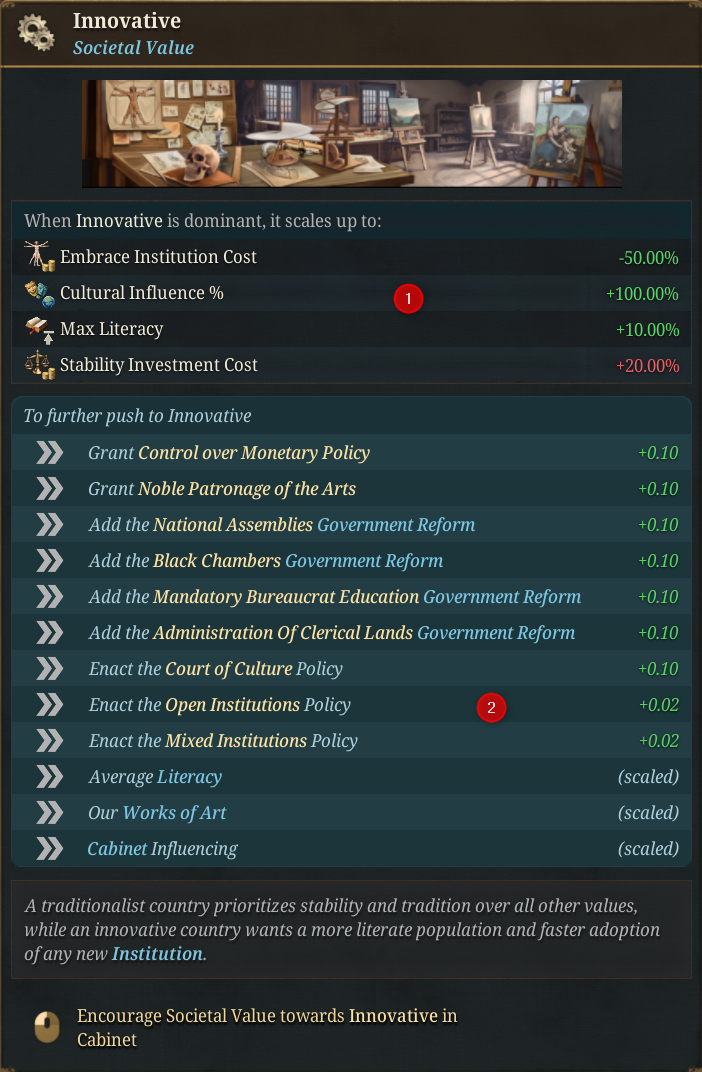
This screen is telling you (1) what the maximum modifiers would be at 100 progress, and (2) what privileges, reforms and laws you could be using to push it further. It also tells you what passive, scaled modifiers impact the monthly progress – in the example above, average literacy, works of art and Cabinet.
What values do
Most simply, values in EU5 give modifiers to multiple in-game mechanics. Most of these modifiers are positive but many values have negative modifiers as well:
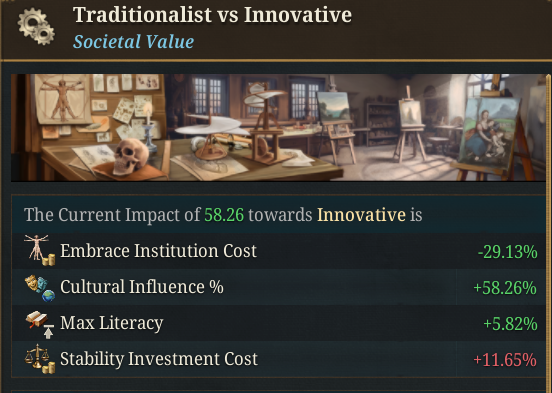
My nation is quite Innovative, meaning that it is 29% cheaper to embrace institutions and I get 58% more Cultural Influence and 6% more max Literacy. It also, however, makes it 12% more expensive for me to push my stability up, costing more Gold.
Values also unlock certain government Reforms (the Crown version of Estate privileges) and events once they’re at certain levels.
How Values Move
Values move in one of two ways: monthly progress, which gives a small push in one direction or another each month until a cap is reached, and flat progress, when the value shifts all at once.
Monthly progress is the amount by which a value moves every month. It will continue shifting by that amount in that direction until it hits a cap which is 100x the monthly progress.
In the example below, I have net progress of 0.16 per month towards Conciliatory. The slider will keep moving towards Conciliatory until I hit 16.0, then it will stop.
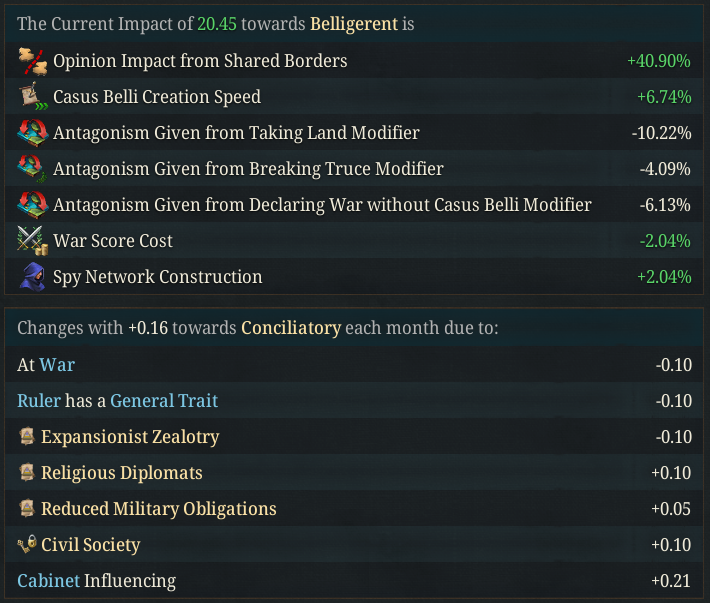
Note that there are modifiers in both directions, with my Cabinet member, the law Civil Society and the privileges Reduced Military Obligations and Religious Diplomats pushing towards Conciliatory, and the privilege Expansionist Zealotry as well as the facts that I’m at war and my ruler has a general trait pushing me back towards Belligerent.
Given I was planning on moving towards Conciliatory in this game, I made a mistake by making my ruler a general and letting him get a General trait. I would have done better to keep him in charge of a navy that was never going to see combat, like a trade fleet. Scrub indeed.
Values are usually, though not always, most powerful when maxed out, so you will be trying to get as much progress as possible in a given direction. To get the full benefit from drift alone you’d need to get 1.0 in monthly progress, which can be very tricky.
Fortunately, and unlike other modifiers like Estate Satisfaction, values in EU5 do not reduce down to an equilibrium – if I can get to more than 25 Conciliatory it will stay there unless I start seeing monthly progress towards Belligerent. So if we can find ways to push our values after the monthly progress has capped out we will get further benefits.
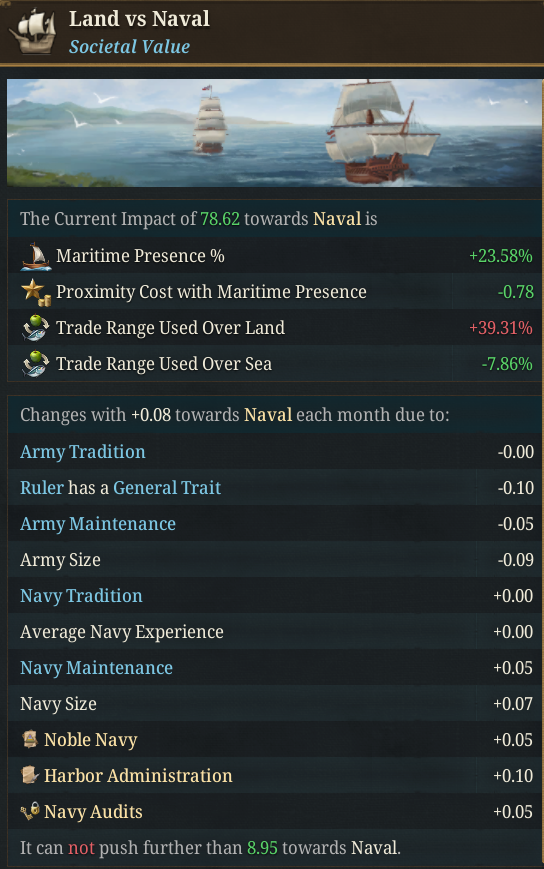
What affects monthly progress
The main sources of monthly progress are:
- Estate privileges, which almost always include value drift alongside satisfaction and estate power modifiers
- Government reforms
- Laws
- A cabinet action which depending on your cabinet efficiency can be very powerful (but only lasts as long as you have a cabinet member assigned), and
- Religious aspects or schools.
Each value is also impacted by unique factors – for example, making your ruler a general will add progress to Land while making them an admiral will add progress to Naval.
When progress is maxed out
Once your estate privileges and laws are settled down you will eventually hit the maximum progress for each value. Once the value reaches this limit, there will be no more monthly progress. Further progress happens by:
- Events, which will often give you a choice with 2-10 flat progress in one direction or another
- Parliament issues, including some issues such as Develop the Interior, which gives Naval progress when failed, and
- Actions taken during Parliament, where you can receive some Parliament support in exchange for a one-off bump of progress.
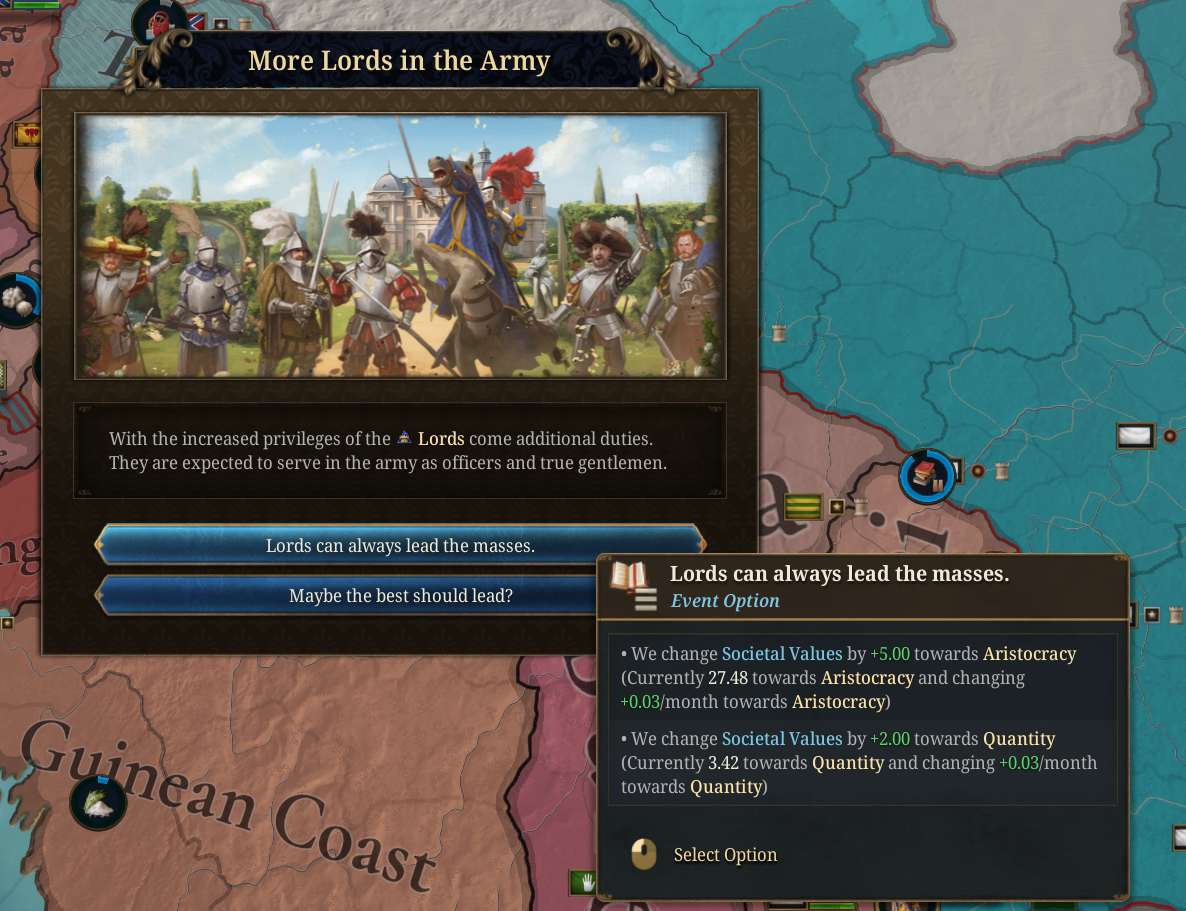

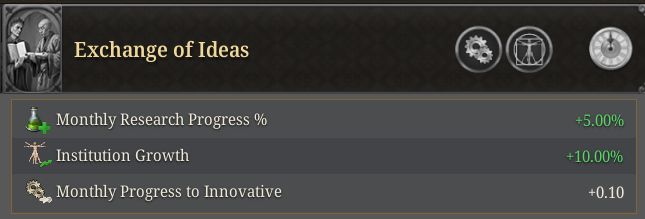
Continuing to push values higher not only makes the bonuses more powerful, but once you get a value over 50 you start getting unique events (not all of which are positive) and access to Government Reforms, some of which are very powerful:
Trade offs and strategy
Whilst powerful, very few values are worth, for example, tanking your Crown Power for. You want to keep values in mind when setting laws, assigning privileges and making choices on events, but it can never be the only consideration. A reasonable strategy is:
- See which values you can and can’t change. If you’re going to have a lot of subjects you will be pushing Decentralisation, no matter how much you’d rather not. Monarchies often struggle to get away from Aristocracy in the first century, and trying to do so can cause problems with Estate loyalty and Stability.
- For the ones you can change, decide which side you’d rather push towards.
- Over time, set your privileges and laws so that you have a decent amount of monthly progress, enough to get some benefit and also to ensure that it won’t start going backwards if you have to change a law later on.
- Once the monthly progress is capped, use your Cabinet to get a further push.
- Once that caps out, move your Cabinet member on and use Parliaments and events to keep moving in the right direction.
Your preferred values might change over time. If you flip religions early game you will want as much Spiritualist as possible, but once everything is converted it’s often better to flip back to Humanist for the culture conversion bonuses. Remember that values are designed to be slow burners, long-term investments that build up benefit over time.
Think about Parliaments and Estate privilege revocations as a limited resource that you can spend only a little bit of at a time. What are your highest priorities? What do we want to change first and what can wait until later?
Some of the key trade-offs you will need to think about are:
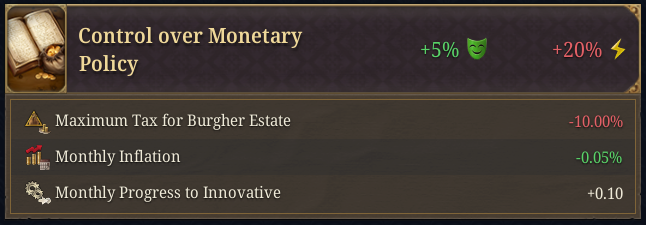
Estate privileges – I don’t want to give my Burghers -10% maximum tax, and -0.05% monthly Inflation isn’t worth it, but I might do so anyway to get +0.10 monthly progress to Innovative:
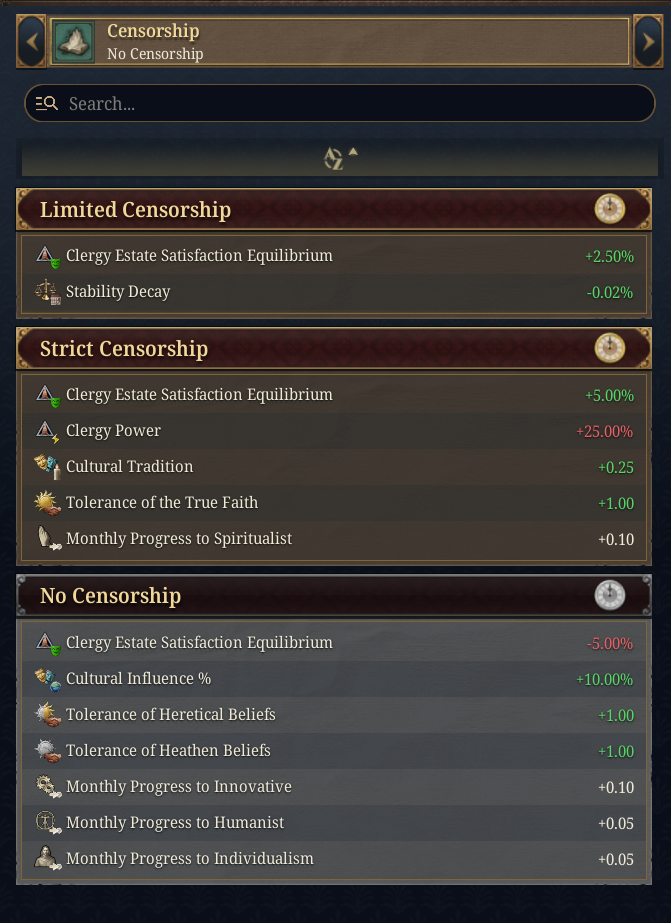
Laws – No Censorship gives me Innovative and Humanist, both of which I’m aiming for in this run, but also Individualism, which I don’t want. It also gives me -5% Clergy Satisfaction Equilibrium, which impacts research speed.
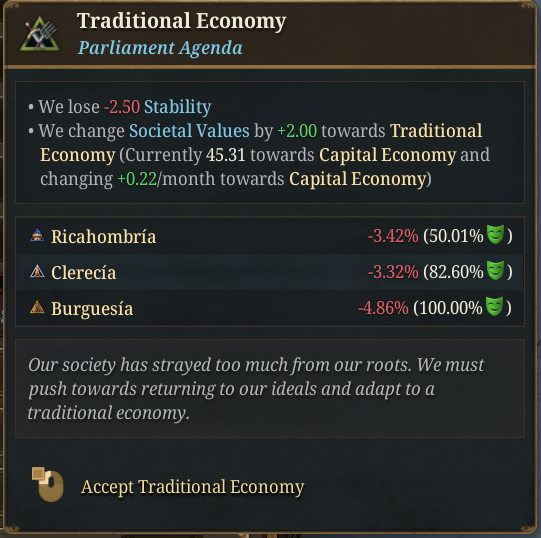
Parliament Agendas – these are essential to getting your issues passed, and sometimes you will get Agendas to push values in the direction you want, but equally as often the agendas will be in the wrong direction. They also hurt Estate satisfaction and Stability.
Final words
Values are one of those mechanics in Paradox games that you’re at perfect liberty to ignore and let fall where they may – but also act as a powerful multiplier if done right. You can’t and shouldn’t prioritise values over all else but by having a strategy in mind and slowly working towards it you will make it easier to meet your goals.
Longum regnum tibi!