
For the first couple of centuries of EU5, the most efficient way to get newly conquered land into your empire and producing value for you is via the use of subjects. You can release unintegrated land as subjects and, after 10 years, annex them, getting cores on all of their land.
Done right, you should be able to expand at almost any pace you want, with the limiting factor probably Antagonism rather than your ability to deal with new land:
Today we will look at how to release subjects, how to manage them, and how to annex them to expand as swiftly as possible. We will not be going into custom subject types such as Dominions, Appanages or Beyliks – these can often be very strong but are generally dealt with the same way as regular subjects. We are also focused on the first 200 years of the game, when expansion needs to be managed more carefully, and I’m assuming that you want to have subjects for the purpose of annexing them and expanding (not a long term thing, baby).
| Written | January 2026 |
| Up to date for | 1.0.10 |
| Scrub level | 1/3 (noob) |
When to Release Subjects
When you conquer land from an enemy, it counts as “unintegrated”, giving you some pretty serious debuffs and making the land essentially useless. Let’s look at some land I’ve just taken from the French:
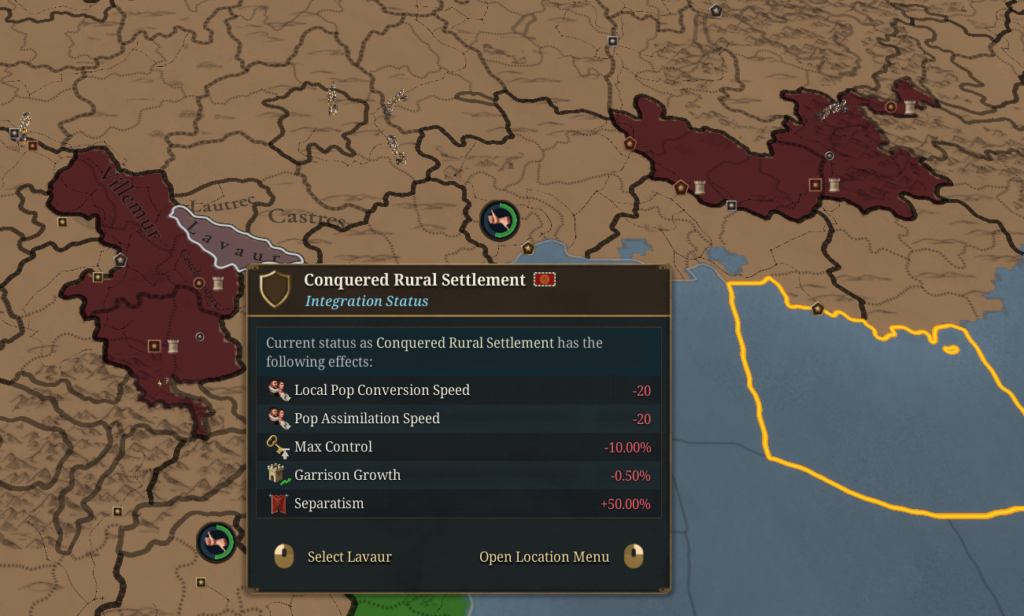
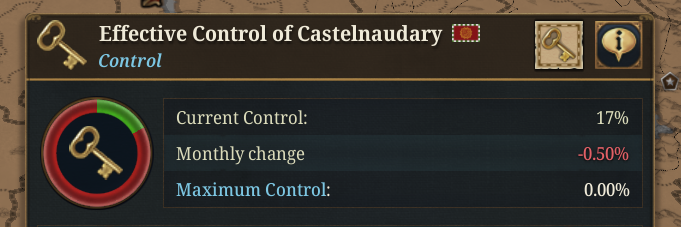
In order to get any value from the land, we need to integrate it. This is 1524 and I’ve stacked as much Cabinet Efficiency as I could, as well as picking up the Speed of Integration techs:
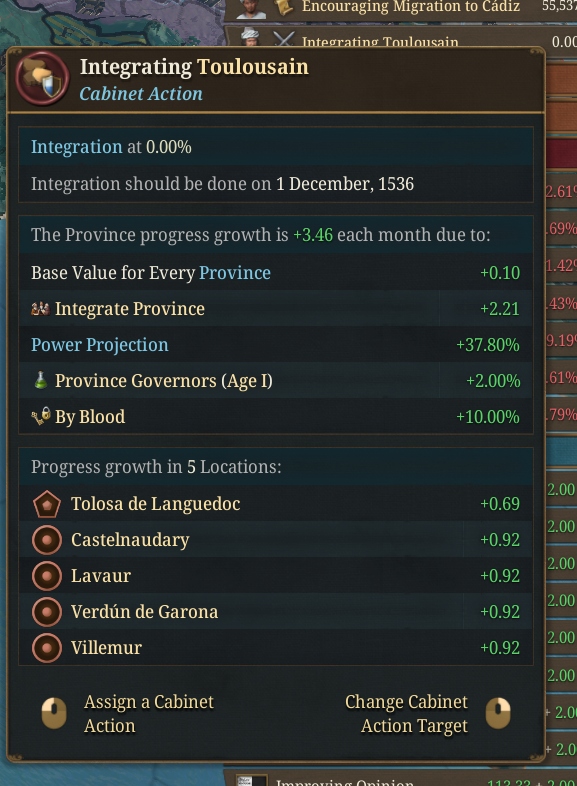
And it’s going to take 12 years. This could be worse – the province only has one city and the rest are rural locations. Towns are much slower to integrate then rural locations.
I’ve conquered four provinces (it was a small war), so with all four of my Cabinet members I could have them integrated and ready for another war in 12 years. This isn’t very efficient!
Depending on how valuable your Cabinet members are to you, it may or may not be worth directly integrating one or two locations at a time. I usually find that I have a long list of Cabinet tasks waiting for me and so almost never directly integrate land in the early game.
Historical vs Non-Historical and Vassals vs Fiefdoms
We can release subjects directly from the Diplomacy tab, and immediately we have a choice:
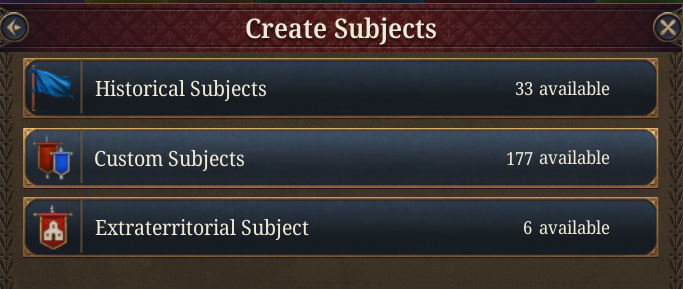
We will ignore Extraterritorial Subjects for now, and look at Historical vs Custom. Historical Subjects are nations that either existed at the start of the game and were annexed/conquered, or existed prior to the start of the game and were put in by the devs. Custom Subjects allow you to create new nations out of just the land.
The key advantage of a Historical Subject is that they may already have Cores on your enemies, allowing them to fabricate claims via Spy Networks and saving you a Parliament. They are pretty good at doing this too, usually generating claims within 5 years of being released. We can see a map of what’s available:
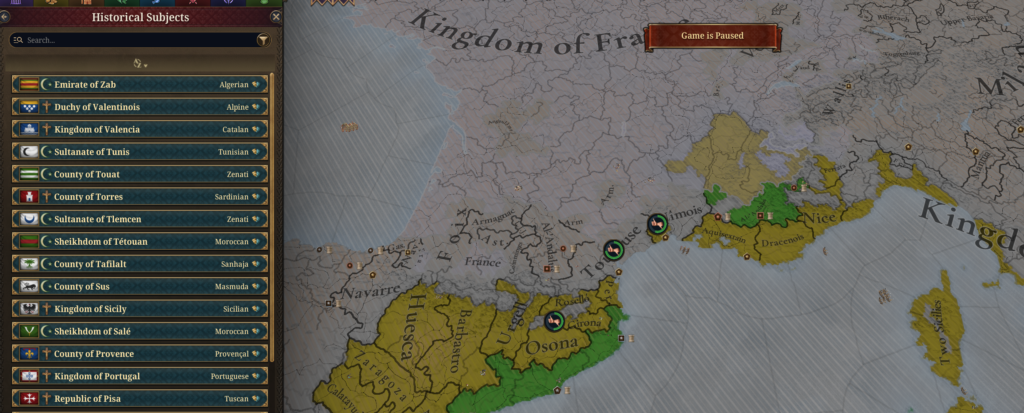
Another benefit of Historical vassals is that they start with cores, where Custom vassals have to integrate their own capitals.
The Toulousian land I conquered doesn’t have any historical subjects to release, but Avignon does. Selecting this, we get another choice:
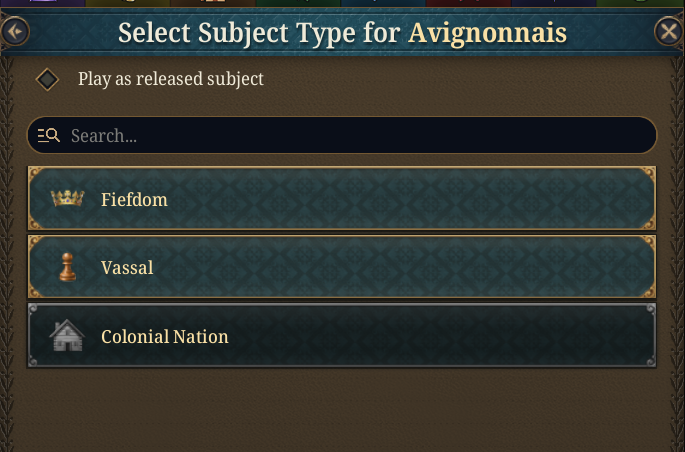
Fiefdoms and Vassals are very similar mechanically, but have some differences:
Fiefdom
- Uses the ruler of the master nation (i.e., you)
- 50% Institution spread in both directions
- The Fiefdom is never blocked from changing religions
- Fiefdoms get +10 loyalty to overlord
Vassal
- You choose the ruler when releasing them
- 20% Institution spread in both directions
- The Vassal may be blocked from changing religions (but not necessarily)
In early patches, Fiefdoms could use a Parliament issue to give “their” ruler +3/+3/+3 and with enough subjects you could get a god-tier ruler in just a decade or so. This was removed in 1.0.10
Both kinds get the following:
- Subject is diplomatically limited – they are not allowed to declare wars, make alliances, guarantee or any of the other usual diplomatic actions independently of the overlord
- Subjects may make their own subjects (but usually don’t)
- Subjects will join all wars of the overlord
- Subjects give Food and Military Access to their overlord
- Overlord can build buildings, RGOs and roads in the subject
- Subjects can be annexed after 10 years at a base rate of 1.00 (more on this later), if they have +150 opinion of the overlord and are not rebellious
- Subjects have +5% Cabinet Efficiency
And the ruling nation gets:
- Cost of 0.02 Diplomatic Capacity at base (this goes up as the subject gets bigger)
- Monthly progress of 0.02 towards Decentralization
Because of the extra +10 loyalty and the extra Institution spread, Fiefdoms are generally superior. You should not, however, make all subjects Fiefdoms because Vassals and Fiefdoms count their collective strength separately for the purposes of Loyalty. This means that if you have 10 subjects with a collective modifier of -10 “Country Strength of all Countries vs Overlord”, you can make half of them Vassals and half Fiefdoms and only get -5 each. This is very helpful if you have a lot of subjects, allowing you to essentially double your subject count before running into Loyalty problems.
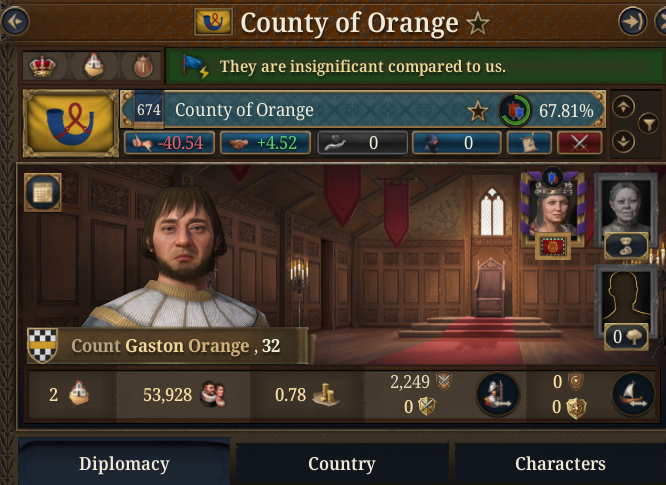
In this case, my Fiefdoms are receiving -20 Loyalty from this modifier, and my Vassals none, so I will release Avignon as a Vassal:
Subject Size
One more Historical Vassal takes care of the conquered land around Avignon and Forcalquier, leaving the chunk of land around Tolosa:
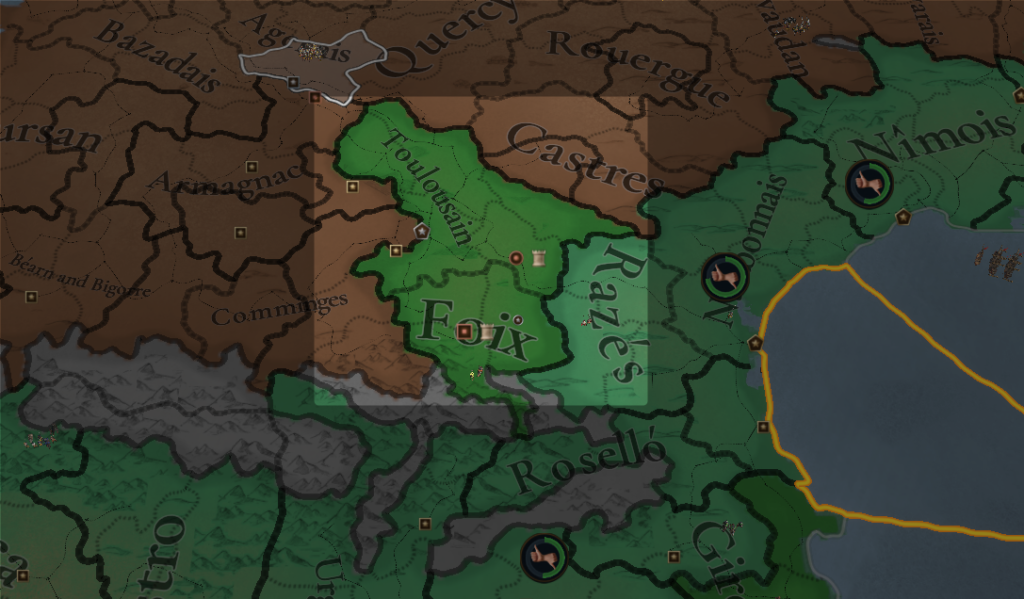
There are no worthwhile Historical nations here so I will release custom subjects. The question is – one or two? I can release as little as one province per subject, or release one and give them more land. I could even grant this land to my existing subject based in Razes. There are advantages and disadvantages to both:
Many smaller subjects
+ Smaller subjects will generally have higher Loyalty
+ They will be faster to annex per pop or per location due to the “much larger than” modifier
+ If you are forcing them to culture or religion convert, they will be able to do so quicker with only one province
– With fewer places to spend their money, small subjects left un-annexed for too long may over-urbanise, harming valuable RGOs and wasting money on buildings that you will later delete
+/- Small subjects with spare Cabinet members will Develop their locations – improving long term value to the overlord but making them slower to annex
– Smaller subjects are more Diplomat-intensive to improve opinion on and annex
Fewer larger subjects
+ Fewer Diplomats (and thus less money) required to improve relations and annex
+ Lower cost in Diplomatic Capacity
– Generally lower Loyalty
– Slower overall to annex
+ May be more useful in war with larger stacks acting independently, less prone to being insta-wiped by the AI
– Slower to convert religion or culture across multiple provinces
+/- Less monthly progress to Decentralization
There is no one answer here and usually a mix of the two is ideal. For nearby land to which you can propagate Control easily, you will probably want smaller subjects that can be easily annexed or that will culture convert for you quickly.
In 1.0.10 there is a known bug where subjects can but won’t culture convert under some circumstances. This is likely to be fixed in 1.0.11
If you are trying to remain Centralized, or are short of Diplomatic Capacity or Diplomats, you may prefer larger subjects. Larger subjects are also generally less “annoying” or micro-intensive to manage.
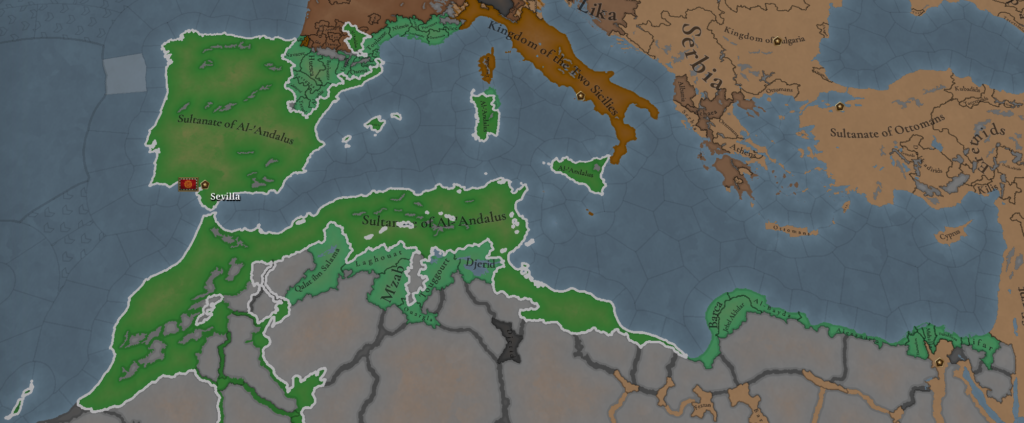
In the Sultanate of Al-Andalus in 1524, we have 36 non-Colonial subjects and have heavily embraced the “smaller is better” side of the argument:
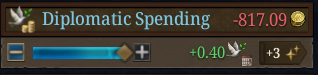
This strategy has enabled me to annex subjects two at a time in just a couple of years but also required me to spend 100+ years with my Diplo slider maxed:
I’ve also not been worrying about religious and cultural conversion as I’m trying to go for a humanist, max-Tolerance run with high Dhimmi taxes.
I will soon, however, need to start making bigger subjects as I’m now able to conquer new subjects faster than I can improve relations and annex them – that 36 number has been climbing for a while. I also need to consider my Diplomatic Capacity, which is starting to get close to it’s limit:

For these reason I’ll release the provinces of Toulouse and Foix as one vassal (releasing Toulouse first and granting them Foix via the diplomatic interaction).
Having Subjects: Loyalty and Liberty Desire
Every subject has a Loyalty value, which you can see from their country screen (Ctrl-right click on one of their locations):
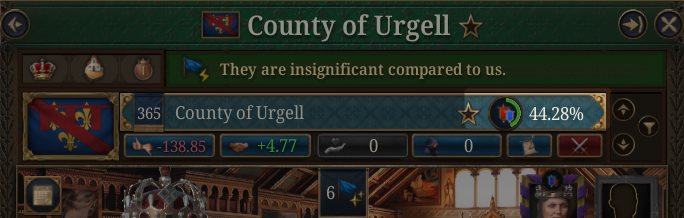
Subjects with Loyalty below 50 are disloyal and pay you less tribute, might not join wars and can even start International Organisations to seek outside support for a rebellion. They can also separate peace in wars, sometimes allowing themselves to be fully annexed by one of your enemies just to spite you.
In practise, if you are large enough, Loyalty below 50 doesn’t matter, and your subjects are unlikely to take action against you. If you’re worried about a subject being annexed in a war, just set them to Scutage so they don’t join your wars.
We can hover over the Loyalty figure to see a breakdown:
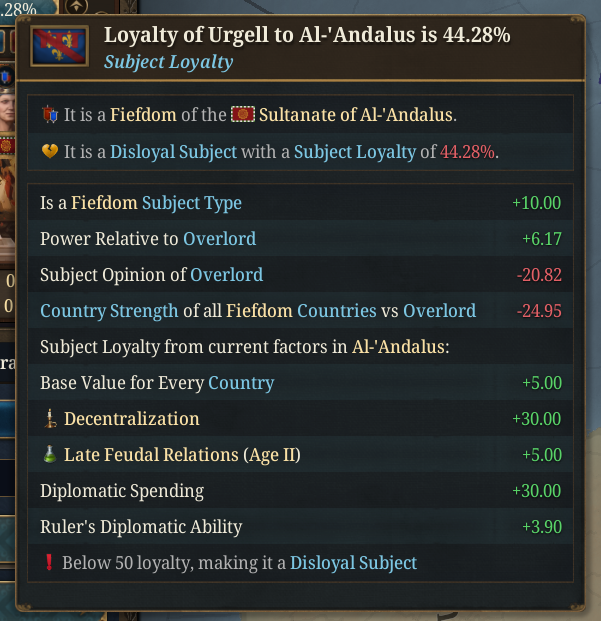
Let’s look at these one by one:
- Firstly, just by being a Fiefdom subject type, they get +10, a very nice modifier that Vassals don’t get
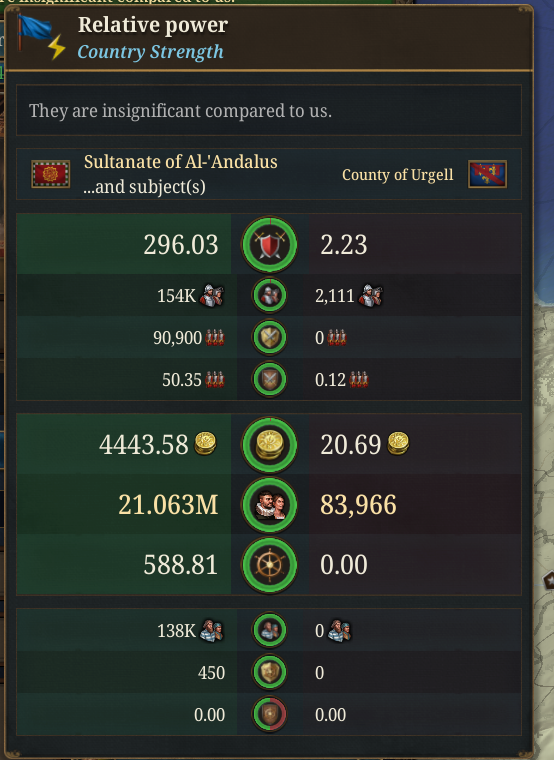
- There is a relative power modifier of +6.17, reflecting that I am much, much more powerful than they are. This is a non-linear modifier that stacks up quickly as your subjects grow in size. In this case I have a relative power of 296 to their 2.2:
- I am losing -20.82 to due to a Subject Opinion of -139 – I haven’t done any improving of relations with this subject yet and they are Catholic to my Sunni. I’m also suffering from a -99 opinion penalty due to having recently annexed other vassals.
- Next is a modifier for the Combined relative power of all Fiefdoms – currently -24.95, this figure will fluctuate with tax base, manpower, and levies. This is a crucial modifier to keep an eye on as it affects all subjects of that type, and letting it get out of hand can make it nearly impossible to annex vassals to get it down. This modifier also appears to be non-linear, so it can ramp up quickly
- There is a Base Value of +5
- I am, mostly thanks to how many subjects I have, 100% towards Decentralization, which grants as it’s main bonus +30 to subject loyalty
- I have a Tech modifier from the Age of Renaissance adding +5
- I have my Diplomatic Slider at maximum, adding a further +30
- Finally, my Ruler (who is trash) has a Diplomatic skill of 39, adding +3.9
All of this adds up to 44.28, not quite enough to keep Urgell loyal. I can get them loyal fairly easily by improving opinion with a Diplomat – though Diplomats are a scarce resource when you have 36 subjects!
Decentralization is quite essential here, if I was fully Centralized I would have -10 instead of +30, making it close to impossible to keep this subject happy without using an interaction.
Because of the relative power modifier, loyalty will grow as I annex vassals, and reduce as I conquer more – I need to keep it in balance for each subject type.
There is one other modifier to Loyalty, called Liberty Desire:
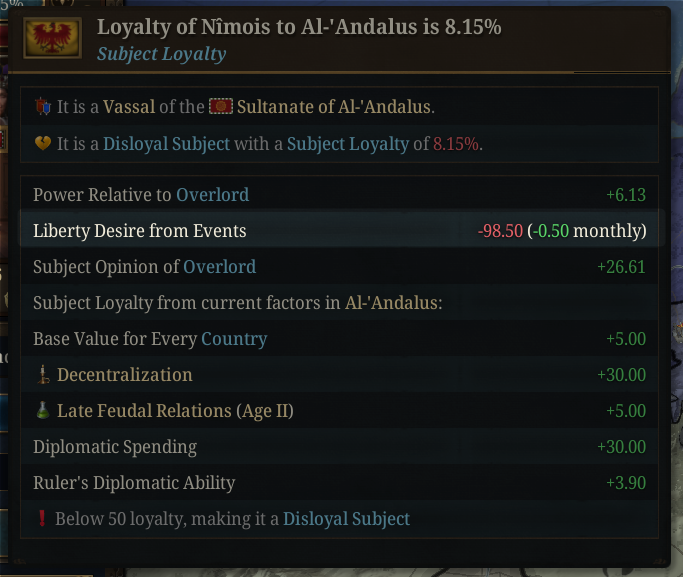
Liberty Desire is a separate value that each subject has that is impacted mostly by events and interactions and decays down to zero. Nimois has 98.5 Liberty Desire from me enforcing culture, which decays down by 0.5 a month. This is quite a quick rate of decay, reaching 50 in 8 years and disappearing completely in a little over 16. Interactions that give subjects Liberty Desire can be valuable as it will eventually decay.
Having Subjects: Interactions
EU5 gives you a lot of options for interacting with your subjects:
- Ask to Improve Cultural Opinion allows you to improve your subject’s culture’s view of yours by one level. This is very significant for Pop Satisfaction once annexed, with Negative/Neutral/Kindred giving -5%/0%/+15% Satisfaction. This can only be used once every 50 years, so plan well.
- Cancel Subject Status releases the subject, with a truce
- Cede Location and Cede Province allow you to give land to your subject. This requires having at least 1 Diplomat but doesn’t use up the Diplomat like other interactions, so you can use it over and over
- Change Policy allows you to change one of their Laws, at the cost of -20 Loyalty for 50 years
- Change subject type between Fiefdom, Vassal and others (if available)
- Divert Trade gives you 50% of both their Trade Capacity and Advantage in all Markets, for -33 Loyalty. This can be very powerful if you are conquering vassals in Markets outside your own.
- Embargo Rival forces them to embargo one of your rivals.
- Enable Scutage increases their monthly payments to you by 25% (so to 25% of their income total) but does not call them to war. Subjects aren’t much help in a lot of wars due to being AI so this can be a good option.
- Enforce Culture and Enforce Religion change the subject’s primary culture or religion to yours, at a cost of 100 Liberty Desire. As of the current patch, subjects are good at converting religion for you, but often won’t try to assimilate cultures.
As of the current patch, subjects are good at converting religion for you, but often won’t try to assimilate cultures, due to a bug in how they calculate whether or not it’s worth it. Note also that subjects are released with your Spiritualist vs Humanist value, so if you have a large modifier preventing assimilation or conversion, they will inherit it.
- Install New Ruler (Vassals only) changes ruler, if the current ruler doesn’t have an heir.
- Pay off Debt allows you to settle their debts in return for some negative Liberty Desire (so temporary extra Loyalty)
- Press Sailors will steal some of their Sailors, at the cost of 10 Liberty Desire
- Return Land and Seize Territory allow you to give them cores or take them. As of 1.0.10, you don’t get their Cores on seized land, making this less powerful.
- Send Officers both gives the subject some progress towards Institutions you hold and they don’t, and gives them +10% Army Morale and +5 Loyalty. You as the overlord suffer +0.2% Army Tradition Decay. If you need just a little bit more Loyalty to annex a subject this can be very handy – Army Tradition decays very quickly anyway!
- Siphon Income gives you a one-off hit of cash (2x their monthly income) at the cost of 20 Liberty Desire.
- Start Annexation begins annexing the subject. You need 150 opinion and positive Loyalty, and they must have been a subject for at least 10 years.
- Support Loyalists gives the subject +20 Loyalty at a cost of 0.1 Diplomats a month. This pairs well with Divert Trade if you have the spare Diplomats.
- Support Military gives the subject -1% Experience (that’s unit experience) Decay, +0.05 Army Tradition, and -0.1 Monthly Diplomats, at a cost to you of +0.1% Army Tradition Decay.
This is quite a mixed bag of interactions, some essential, some likely rarely used. It is possible to pair Send Officers and Support Military to give your subjects quite a bit of a buff to their armies by tanking your own Army Tradition – but if their armies are big enough to matter, you probably have Loyalty issues anyway and they won’t be joining your wats.
The key ones to look out for are the positive Loyalty modifiers – Support Loyalists, Pay Off Debt, and Send Officers, as you may need to stack some Loyalty in order to annex a subject. Ask to improve cultural opinion, while only available twice a century, is also crucial as it gives you long-term Pop Satisfaction once annexed. Divert Trade (often paired with Support Loyalists to negate the Loyalty problems) is a great way to profit from your subjects.
Annexing Subjects
All good things must come to an end and eventually we will want to control our subject’s land ourselves. To do this, we need to Annex them. Annexing requires:
- The subject to have been a subject for at least 10 years
- Loyalty above 50, and
- Opinion above 150
The last one can be tricky, as you will often be stacking negative opinion from having a different Primary Culture, Religion, as well as a max -100 from annexing other subjects (this decays but if you’re constantly annexing it’ll be close to 100).
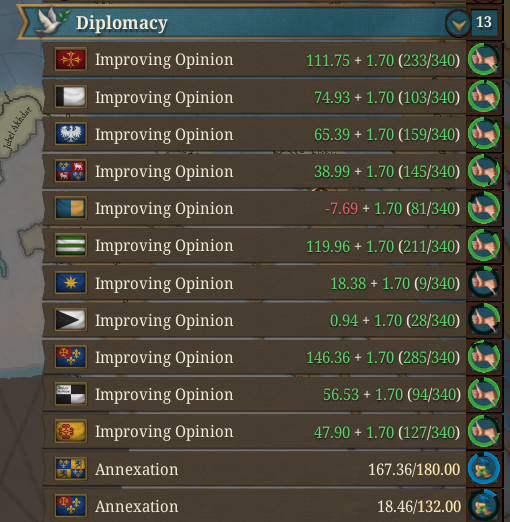
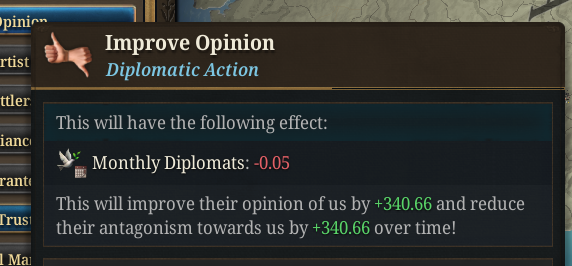
Managing Diplomats and improving relations is important. Ideally you want subjects hitting +150 relations just as you gain enough Diplo space to annex them. This can take a while, so having a Cabinet member on Improve Diplomatic Reputation can be very helpful to speed things up. This also impacts the cap – in EU5, the most you can improve relations by is a multiple of the monthly Improve Relations, so you can get enough Improve Relations to overcome a LOT of negatives:
While annexing, all of your other subjects will get a -25 opinion modifier, you will lose 0.1 Diplomats a month, and your Antagonism with other nations will decay slower by 0.01 (which is a relatively small effect, usually it’s 2-2.5). Annexation will pause (and the game will not give you a pop-up) if the subject’s opinion falls below 125 or Loyalty below 50.
How long does annexation take? That depends on Annexation Cost and Annexation Speed:
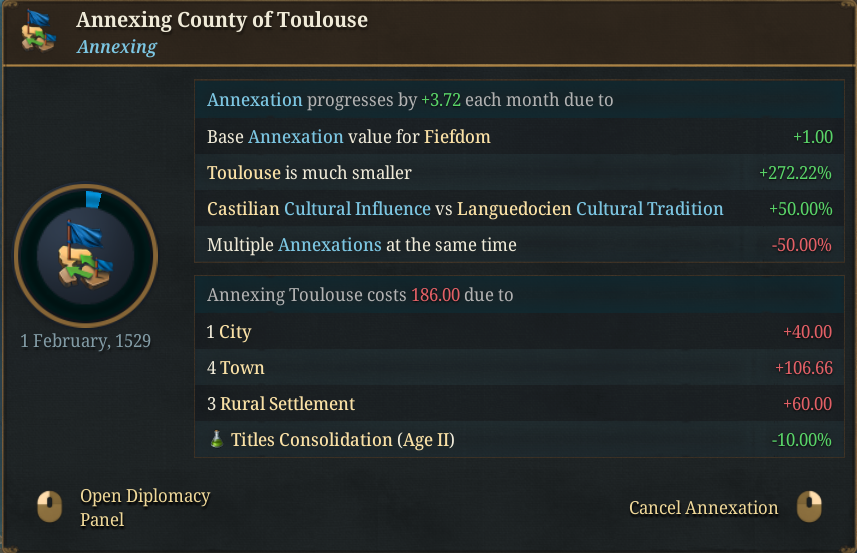
The main factor in cost is location type. Cities cost 40, towns 25 and Rural Settlements 20 each at base. This can then be modified by factors such as Development and global modifiers (like the 10% Tech reduction above). There are some nasty events that make subjects more expensive to annex and the subject themselves can carry out a Cabinet action called Frustrate Annexation to slow you down further. I’m yet to see this happen so I’m not sure if the AI will ever use it.
Subjects left to their own devices for too long will tend to over-urbanise, making annexation more expensive:
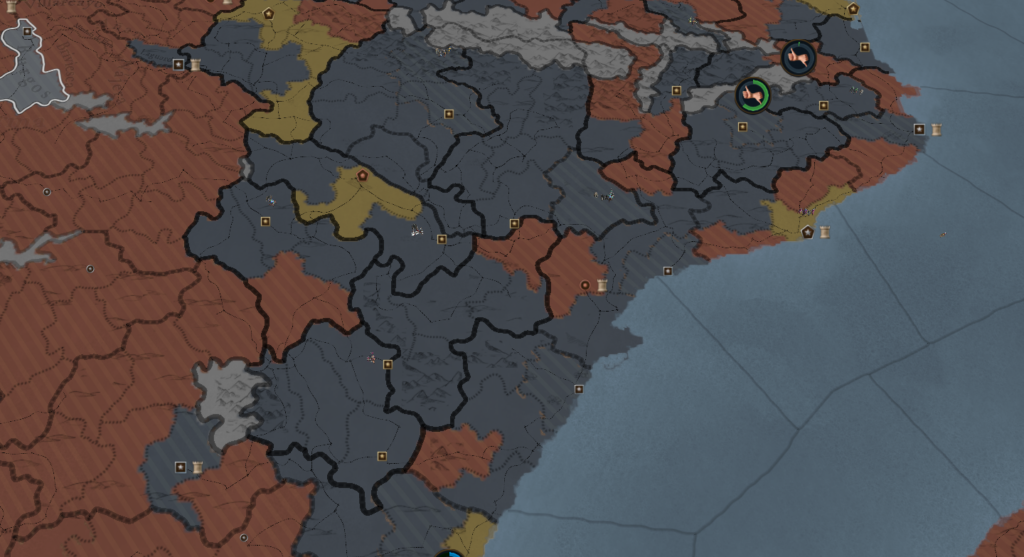
This is doubly inefficient as I will be downgrading about half of these Locations once I annex them. Apart from annexing them quickly, there’s not much you can do to keep the cost down. I try to avoid building in subjects as much as possible so that they aren’t saving up money with which to urbanize.
Annexation Speed is much more flexible. The base is 1.00 per month, so a single province with 1 town and 4 rural locations would take 105 months or nearly 9 years to annex. Fortunately we have a bunch of modifiers:
- up to +50% for having a high Cultural Influence compared to their Cultural Tradition. Influence comes from a bunch of sources but tends to boil down to “be big”, so this will come by itself as you scale. Simply subjugating as much of a Culture’s locations as possible will lower their Tradition. This can be tricky in the very early game.
- Up to +50% for your Culture being the “Dominant Culture” in the subject – not necessarily their primary Culture, and not necessarily the biggest Culture by pop count. I think this is Pops of each Culture multiplied by a flat modifier per Pop class (so Nobles count as more, etc) but can’t be sure.
- -50% for each annexation happening simultaneously. This does not mean you should only ever do one at once – because the multipliers add, so long as you have sufficient positive modifiers to offset it is more efficient on time to do multiple annexations.
- The big one – up to 500% (maybe more?) for being much larger than your subject. I haven’t been able to figure out the formula but for single-province subjects it’s relatively easy to ramp up to 200% and very hard to get over 400%.
From this, the optimal strategy seems to be to have subjects who are a lot smaller than you, and annex as many at the same time as you can within the bounds of Diplomat availability and the modifiers available. As you get bigger, you can annex bigger and bigger subjects while retaining at least a 250% speed boost.
The TL;DR
- Early in the game, subjects are by far the most efficient way to expand (unless you’re literally Timur)
- Use Historical subjects to generate claims – you can game this by conquering and releasing single-Location subjects for good CBs
- Use a mix of Fiefdoms, Vassals and any custom types you have available to minimize Loyalty loss from subject size
- Consider how big you want each subject to be, balancing annexation time, conversion and assimilation, Centralization vs Decentralization and Diplomat cost
- The Loyalty modifier from combined subject strength can sneak up on you quickly – keep an eye on it and be ready to quickly annex some subjects if needed to keep it down
- Don’t stress too much about Loyalty but know you have tools to manage it – Decentralization, subject interactions, Diplo slider, and opinion
- Good interactions to consider are Ask to Improve Cultural Opinion, Divert Trade, Enforce Culture and Religion, and Support Loyalists.
- Keep your subjects small early to annex them quicker, and annex multiple at once if you have good modifiers. Try to annex them quickly to avoid over-urbanizing.
Longum regnum tibi!