
EU5’s economy is very complex and has a lot of moving parts. A single building investment might need to take into account Proximity, Control, the price of goods, Market Access, Estate profits, and Food.
This article is intended not as a comprehensive guide to the economy, nor to tell you what to build when, but as an introduction to the important concepts and how to approach them, sort of a glossary. The information here should help you make your own decisions about what, where and when to build.
| Written | December 2025 |
| Up to date for | 1.0.10 |
| Scrub level | 1/3 (noob) |
Goods and Prices
Your economy runs on Goods. This is the physical “stuff” created by RGOs and production buildings and consumed by pops and armies.
Goods are created, used, bought and sold within Markets (see below), and you can see the Goods for each Market either under the Production tab or in the Market screen (the Market screen has more easily accessible information):
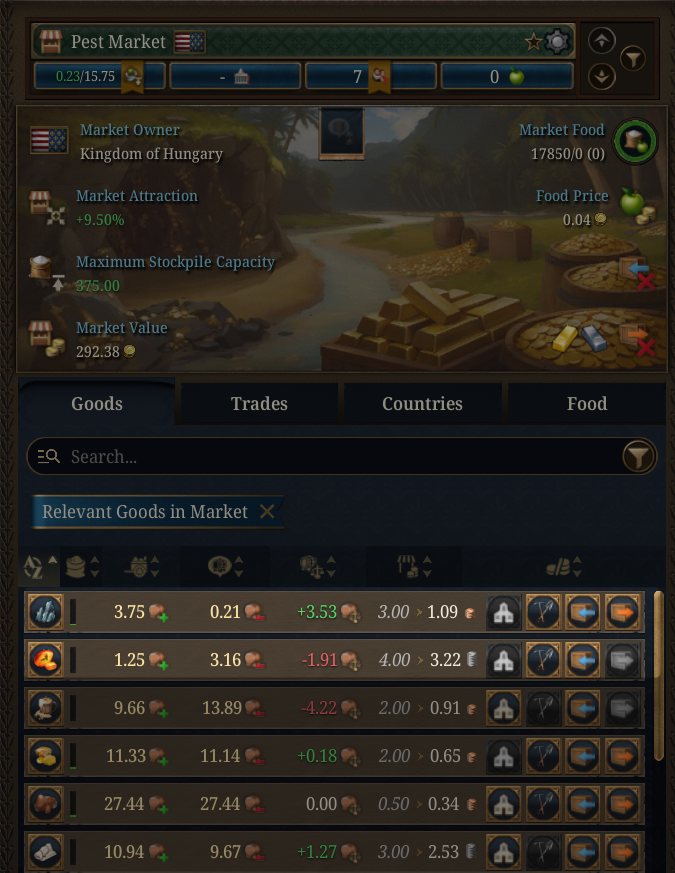
Here you can see that the Pest market has a surplus of Alum (the top one), with 3.75 supply and only 0.21 demand. The price is, as a consequence, very low, and we can only sell extra units of Alum to the market for 1.09 instead of the gamewide “base” price of 3.00.
This will make our Alum production less profitable but might create opportunities for trade, if another market has a shortage and a high price.
In the second row we see a shortage of Amber, with 3.16 demand and only 1.25 supply. The price is still low but if we hover over the price we see it’s increasing, slowly moving to a “target price” of 6.58:
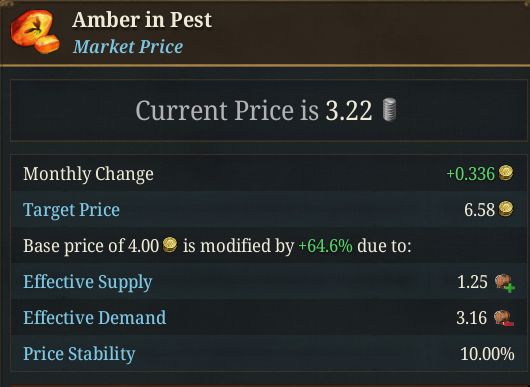
High or low prices are not necessarily bad, but it’s a good idea to try to fulfill all of your market’s needs whenever possible. This isn’t always easy – it’s hard to get hold of Incense in Europe in 1337, for example – but a market with fulfilled needs will have happy pops and profitable buildings.
Where does the supply and demand come from? If we mouse over the numbers, we see:
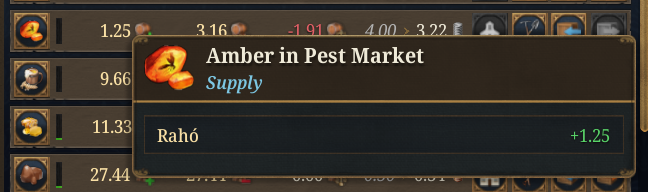
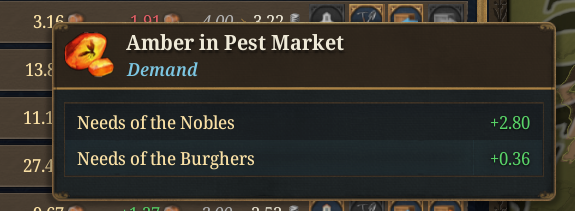
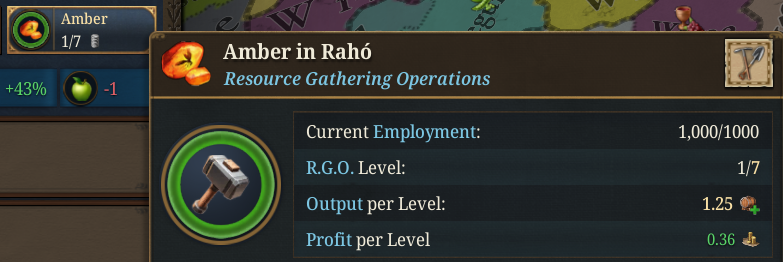
The supply comes from a single location, Raho, which is providing 1.25 Amber, and the demand is mostly Nobles (and some Burghers), who will presumably use it to decorate their giant mansions.
This lack of supply is both a problem – our pops will be unhappy if they can’t get amber knickknacks for the stately manse – and an opportunity, because we can make a profit by building up the Amber production in Raho and selling it to them:
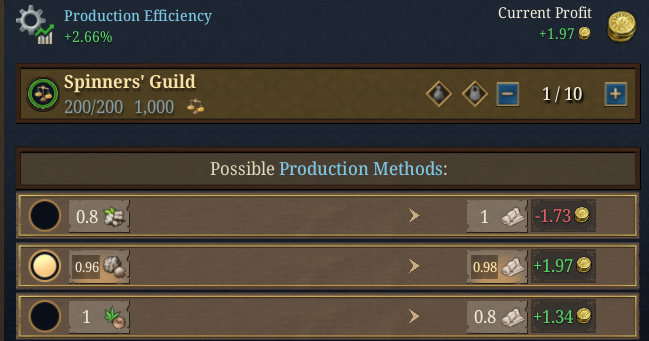
Prices also impact our production buildings by making them more or less profitable – the ideal production building has cheap inputs and expensive outputs.
Two goods to keep an eye on are Lumber and Masonry. These are used to expand RGOs and build urban buildings, respectively, and if you can get their prices low you can get up to a 33% discount on RGOs and buildings, which is massive. There are other goods used sometimes (glass, tools, paper, etc) but these are the main ones.
Resource Gathering Operations (RGOs)
Raw materials like Iron, Lumber and Wheat come directly from Locations via Resource Gathering Operations or RGOs. Each location has one and it doesn’t change outside of special events like the Columbian Exchange.
RGOs are the absolute bedrock of your economy – without expanding them your buildings will swiftly become worthless and your pops unhappy (or dead). Building up your RGOs, and conquering more, is one of the key economic decisions we make.
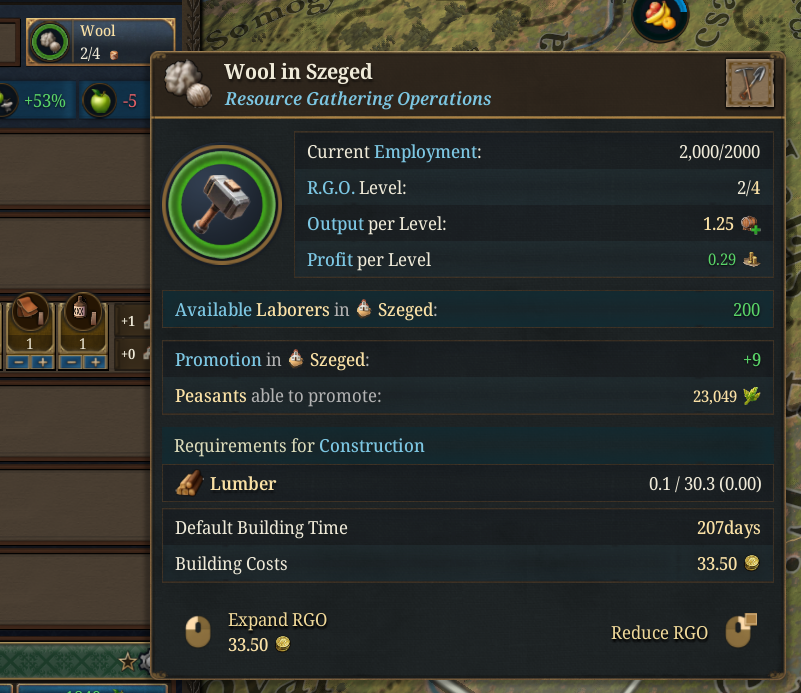
Above we can see the Szeged has 2 (of 4 possible) levels of Wool, each producing 1.25 Wool and selling it to the market. This Wool can be purchased directly by pops, used to make Cloth or Fine Cloth, or traded to other nations.
There is a lot of confusion about the role of Market Access in RGOs. All 1.25 Wool will reach the market, but only 84% of it (multiplied by market access) will be counted towards our income, before Control.
We can upgrade the RGO by up to 2 more levels, increasing it’s output to 2.50 and employing 2,000 extra Peasants as Labourers. Later on, technology, privileges, laws and Reforms will allow us to add more levels.
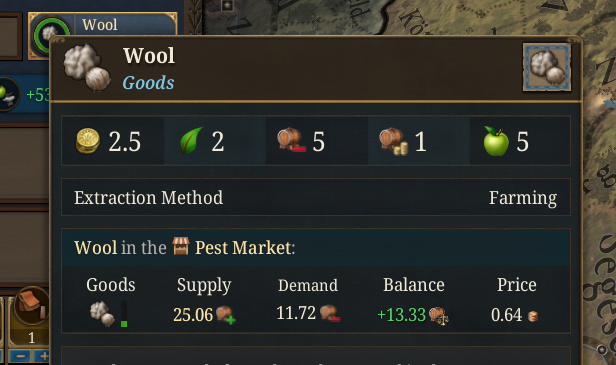
Mousing over the Wool icon itself tells us that Wool have a base price of 2.5 (though our local price is super low at 0.64), has 2 sources, 5 consumers (buildings that use it), a trade weight of 1, and provides 5 units of food from killing all the baby lambs. More on Food later.
Production Buildings
Wool itself isn’t very valuable and none of our pops will buy it, so we need to turn it into something more valuable. To do this, we will build a Spinner’s Guild:
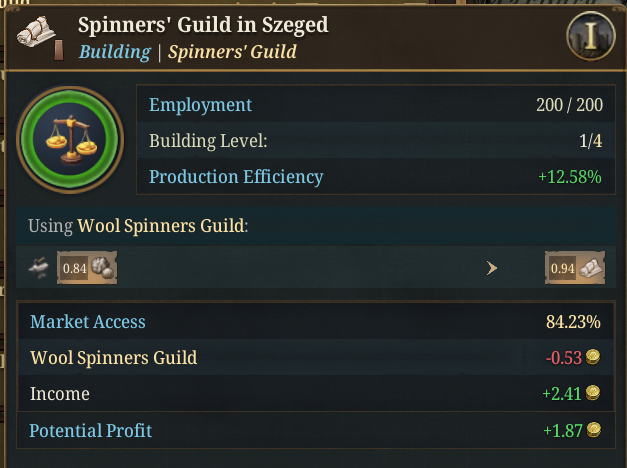
A Spinner’s Guild in Szeged is going to buy 0.84 Wool from the market, employ 200 Burghers, and use it to generate 0.94 Cloth. Taking into account Market Access, the cost of Wool and the cost of Cloth, this will give us a profit of 1.87, which we can tax.
The building will cost about 35 gold so this is a pretty good investment. It will also help keep the price of Wool from crashing too low, making our Wool RGOs continue to be profitable.
The Burghers employed by the building will be “promoted” from the peasantry and will increase the demand across a wide range of goods (including Cloth itself)
Production buildings have to buy their input goods from the market and so can be (and often are!) unprofitable. RGOs have no inputs so are always profitable, but the profit can get very low for cheap goods.
Control and Proximity
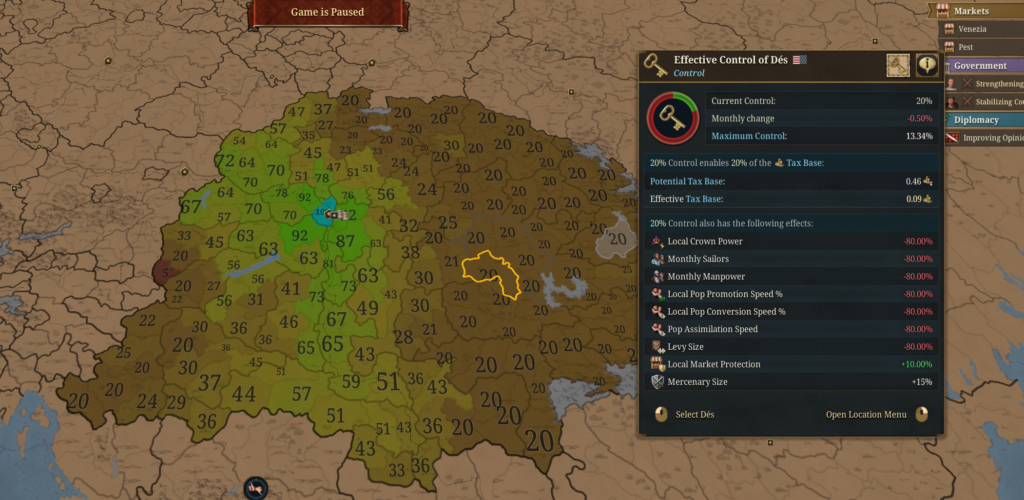
Every location in the game has a Control statistic that modifies almost everything that comes from that location. A location with 50% control will only give you 50% of the tax take, levies and manpower it otherwise would.
Control has a lot of inputs and modifiers but by far the most important is Proximity. Proximity starts with a source, usually the capital, and propagates outwards, location by location. It moves better down rivers and roads and worse across mountains and forests. At the start of the game you can usually only get Proximity a few “steps” from your capital, but via technology and buildings you can build this up to continental empires.
Here’s the control mapmode for Hungary on 1 April 1337:
And here’s the proximity mapmode:
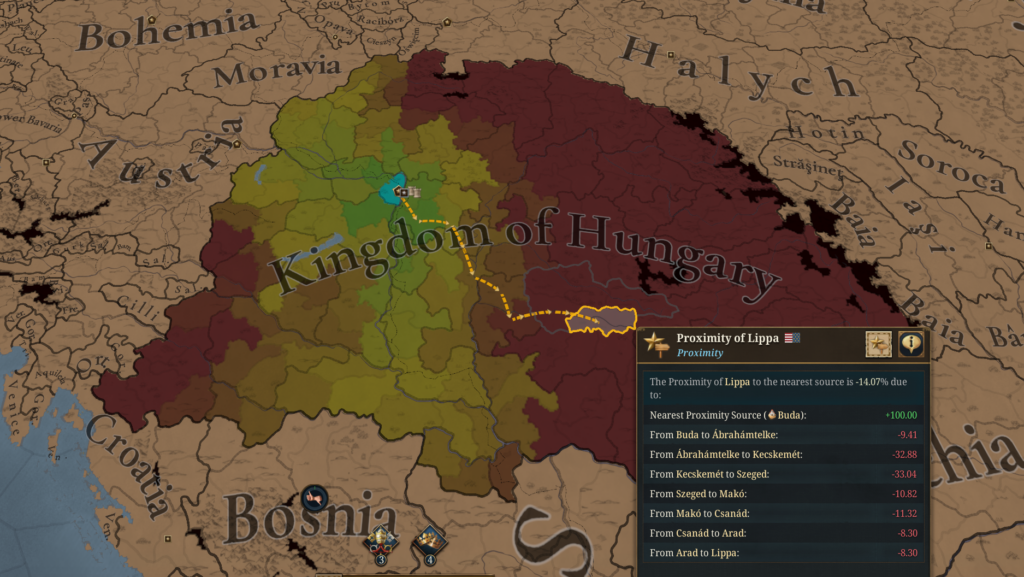
The entire Eastern half of our nation is at 20% control (soon to fall to 15% as population satisfaction is low) and so is effectively 80% lost to us. Buildings will cost just as much but only give us 20% of the return. Because of this, we should always try and build in places where we have high control, or think we will have high control soon.
Markets and Market Access
All the “stuff” in EU5 – the lumber, wheat, weapons and books – gets traded in and between Markets. A Market covers a group of provinces, usually though not always connected by sea or land:
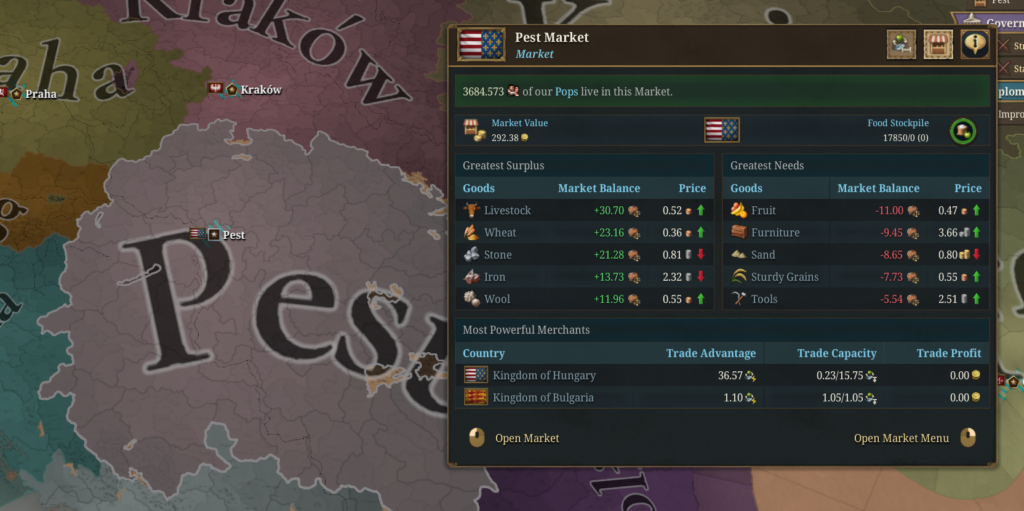
Every month, RGOs and buildings deposit goods into the market, production buildings take some out, nations import or export, and pops buy everything they need to live and work and play from the market.
The supply, demand and trade within a market all contributes to prices, which are different between markets. Goods have a base price which is then adjusted – in the screenshot above, Pest has a big surplus of Livestock so the price is very low at 0.52, but is short of furniture so the price has increased to 3.66.
Production buildings can only provide goods to the market to the extent provided by their Market Access. This Tools Guild should be producing 0.6 units of Tools, but at 49% Market Access it only generates 0.3:
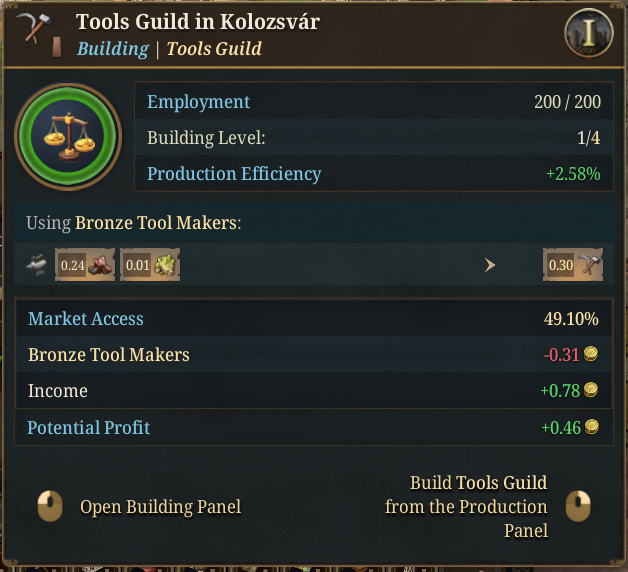
RGOs work differently, with all of the goods reaching the market but Market Access reducing the profits that we will later tax. When and where to create, move and destroy markets is an entire topic on it’s own, but be aware of Market Access when choosing where to build.
Market Access is dynamic, with locations “choosing” a market based on a mix of geographic and political reasons.
Demand and Pops
Building up RGOs and production is only half the economy. The other half is demand. There are four main sources of demand in EU5:
- Pop demands, where all the pops in a market buy food and cloth and horses and furniture
- Building demands, both production buildings buying inputs and religious/government/trade buildings consuming goods to operate,
- Trade demand, what gets sent to other markets for a profit, and
- Army and navy demand, both for building and maintaining units.
You have a lot of control over demand – increasing demand keeps your RGOs and buildings profitable and your merchants in business.
All pops have a basket of goods they will buy from the market, if available. This is dynamic and changes over time but depends mostly on class – Peasants, Labourers and Soldiers consume the least, Clerics and Burghers more, and Nobles most of all (at base prices, a Noble will consume 90x the goods value of a Peasant).
Here you can see that the Burghers in one of my locations are buying the following goods from the market:
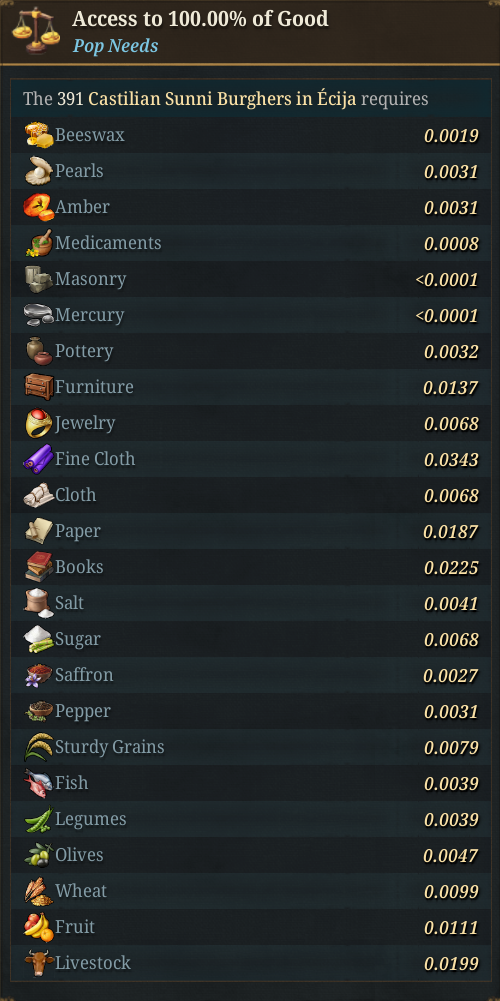
If I grow the population of Burghers – by building more Burghers buildings, or via Values, or tech – this demand will go up. This doesn’t mean I should just spam as many buildings as possible but every additional Burgher will make the goods I produce more valuable and allow for more profitable buildings.
Estate Budgets
Each of your Estates has it’s own budget. Here you can see Castile’s Burghers as of 1494:
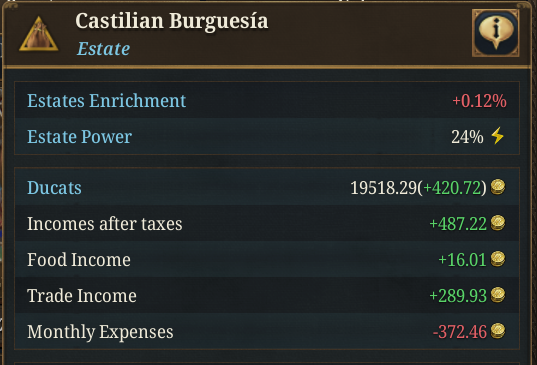
They are making a healthy profit, but this is not guaranteed. My Dhimmi are not doing so well:
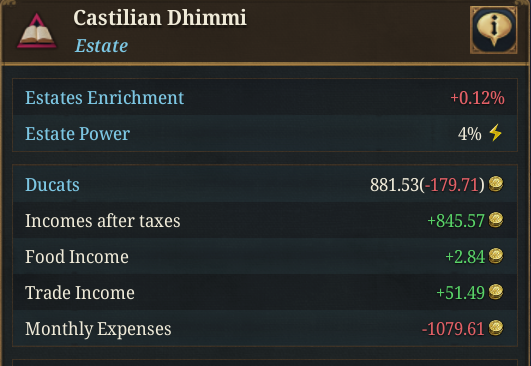
This is probably because all of my high-control, high-profit land is Sunni and the Dhimmi occupy all of the undeveloped, low-Control land, and so can’t earn enough to pay for all of their needs.
Estates earn a share of the profits of every Location, as well as a cut of the trade income. From this they need to buy all of the goods that their Pops demand – food, clothing, furniture, horses etc. Whatever is leftover they will use to build things in your country. Finally, Estates who earn at least 25% “profit” consistently will have increased demand, helping to drive your economy and create opportunities for profit:
You can help keep your Estates profitable by concentrating their populations in places with high Control and Market Access, and even considering closing buildings or de-urbanising when you conquer land over which you have low Control.
You can read much more about Estate economics in EU5 here.
Trade
Once all of the supply in a market has been added in, and all of the local demand taken out, there may be a surplus, which we can trade away. Trade can happen both from nations themselves (i.e., the player and the AI) and from the Burghers of different nations, who get their own pool of Trade Capacity to use.
Trade is all about price differences. Because of dynamic supply and demand pricing (see above), if you have more supply than demand of Saffron it will be cheap in your market, and you can buy low locally and sell high to the French, who have no Saffron. The same goes for every good in the game, whether from an RGO or manufactured.
Trade Capacity comes mostly from Marketplaces, though Market Villages add some and you are given some by any Colonial Nations you have as subjects. Goods have different weights, which determines how much Trade Capacity they use. You need more capacity to trade 1 unit of Elephants than you do 1 unit of Cloves.
But who gets to actually do the trades? If the market has a surplus of five Saffron and two countries each want to export it, who gets the trade? This depends on Trade Advantage. Each nation has a Trade Advantage score in each Market and trades are fulfilled in order from highest to lowest. Trade Advantage mostly comes from owning provinces in a market but you can get more with Maritime Presence (ships patrolling), from subjects and from buildings (including buildings you build in other countries’ locations!)
In most cases it’s fine to leave trade on automatic, or do some trades manually but mostly automatic. Each Market screen has a slider where you can set how much is controlled by the AI.
Tax Base and Economic Base
By adding together all the profits of all the RGOs and buildings in your nation, EU5 will calculate your Tax Base:
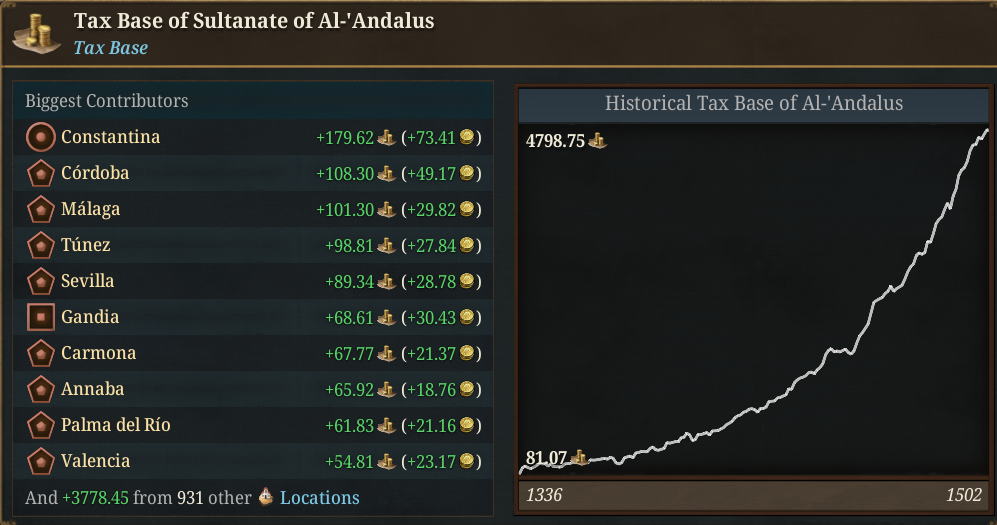
This is used in Great Power calculations, working out subject loyalty, and to set the cost of the Cost of Court, Stability and Diplomatic sliders. Each slider has a different calculation, but adding more buildings will make these sliders more expensive.
Trade is not counted into the Tax Base, but the Economic Base (which drives the Diplomatic and Stability sliders) does include trade profits and Sound Tolls.
Depending on your tax rates and slider settings, it is possible – though not common – for a building to cost more in sliders than it gives you in profits.
The TL;DR
So how does this all fit together, and what should I build? The not-so-simple answer is: it depends. It depends on your goals and your nation and it’s requirements. If you are a powerful European nation with good access to resources you can start urbanizing right away and let the Burghers money printer go brrr. If you’re starting in the Lumber-poor Middle East you will need to build up some production capacity and trade before you can really scale your economy.
If, however, you’re looking for an absolute basic, one-size-fits-all, good-for-most-situations build order, try this:
- If you’re not getting the maximum discount on RGOs requiring lumber and buildings requiring masonry, build (or trade) those. Lumber may require a Tools Guild – Lumbermill – Charcoal Kiln – Bog Iron Smelter production loop which whilst annoying is at least profitable.
- If you have towns or cities without Temples (+5 Control), Wharfs/Docks/Protected Harbours (for Proximity), Libraries (for Literacy), or Hospitals (for Disease Resistance), build those.
- If you have RGOs which are fully employed (not waiting for pop promotion), and will deliver more than 0.5 profit, build those.
- If you have production buildings where the location has no shortage of Burghers/Labourers and will deliver more than 0.5 profit, build those.
- If you have RGOs that don’t provide 0.5 profit, but do provide food when needed or the raw inputs to production buildings (Wool for Spinner’s Guilds, Livestock for Tanneries), build those.
- If none of the above is available, you need to push demand. Build Universities, Cathedrals, Marketplaces, Armories, Bailiffs (for Control in faraway places), Granaries, Irrigation, Counting Houses – anything that uses goods and employs pops.
- If there are RGOs to develop in the 0.2-0.5 profit range that are inputs for your production buildings, build those.
- In amongst all of this, build roads (topic for another day but start at your capital and work your way outwards), and urbanize.
- ???
- Profit
The 0.5 profit limit (which is completely arbitrary and unproven by the way) means that you will only be developing places where you have high Control. The infrastructure buildings in (2) will help create demand but are also essential for propagating Control. RGOs and Production Buildings keep the economy humming and the tax base growing.
You will need to urbanize which is a whole topic on it’s own – building more towns and upgrading them to cities gives you more Burghers and Clergy and Nobles and keeps the whole loop turning.
Longum regnum tibi!