
Estates are those annoying groups of pops that always seem to think they know better than you how your nation should be run (so your average EU5 player). In addition to demanding privileges, requiring bribes for Parliaments and providing your army some target practice in the form of rebels, Estates in EU5 also have their own finances, a sort of “country-within-a-country” that can be leveraged to help develop your nation.
Depending on both the wealth and satisfaction of your Estates, they will build infrastructure and buildings in your nation separately from you. If they are wealthy enough, this can be significant:
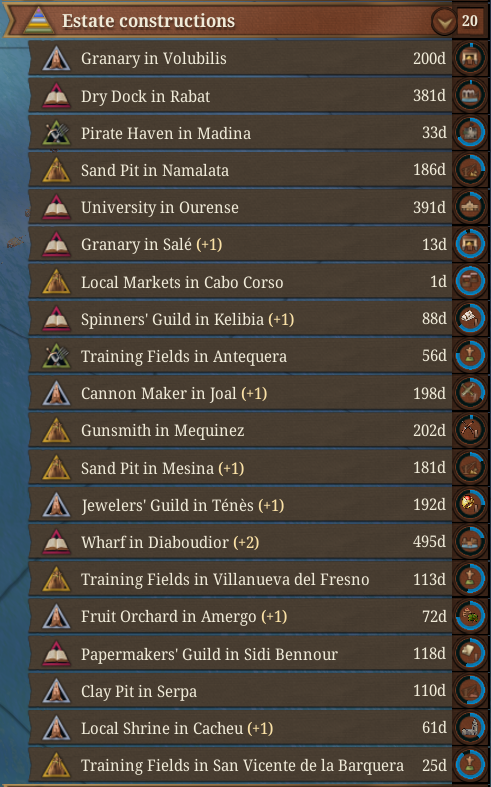
Estate finances can be managed by the player, and today we will look at some examples and at ways we can help our Estates help us.
| Written | December 2025 |
| Up to date for | 1.0.10 |
| Scrub level | 3/3 (Enrique) |
Estate Budgets
In the same screen we manage privileges, we can mouse over each Estate and see it’s budget:
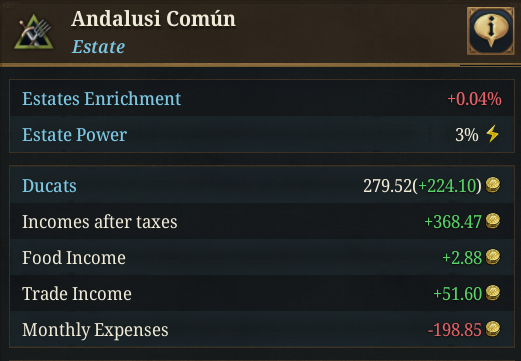
Like the player, each Estate has monthly income and expenses, can can spend their balance on Buildings.
Estate Income
Location income (as opposed to trade income) in EU5 goes through a couple of steps before appearing in your treasury. Once all RGOs and buildings profits are calculated (this is called the Potential Tax Base), they are multiplied by Control and split up amongst the Estates:
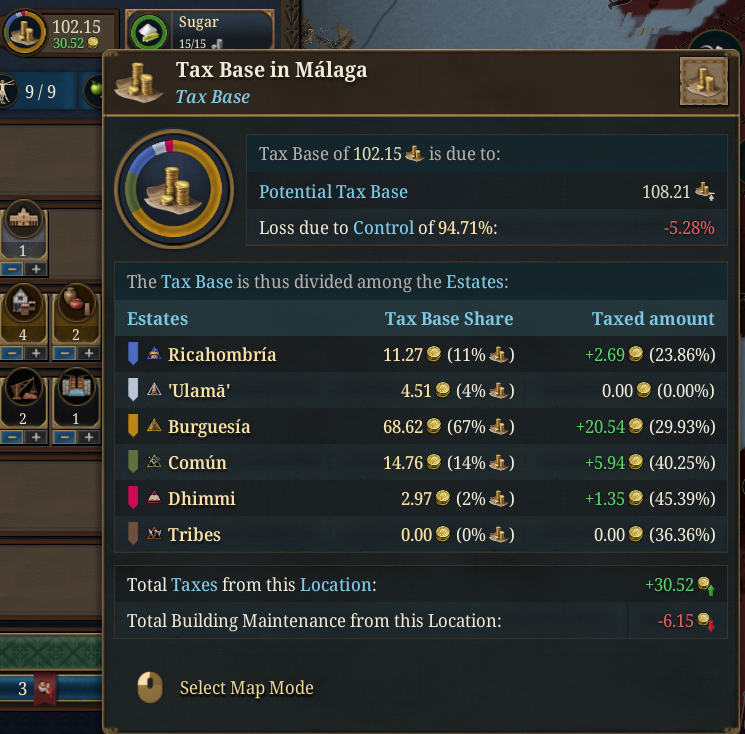
This split doesn’t reflect the national-level Power of each Estate, but instead depends on the relative populations of each estate, plus some modifiers (each Noble counts for much more than each filthy Peasant).
Once the profits are split up, you as the Crown then tax them according to the sliders in your Balance tab. In the example above, you can see that the Burghers (or Burguesia) earn 68.62 gold per month, of which we tax 20.54. So the net income to the Burghers will be 48.08.
Estates also get a cut of trade and the selling of food, which is counted at a national, not provincial, level.
Estate Expenses
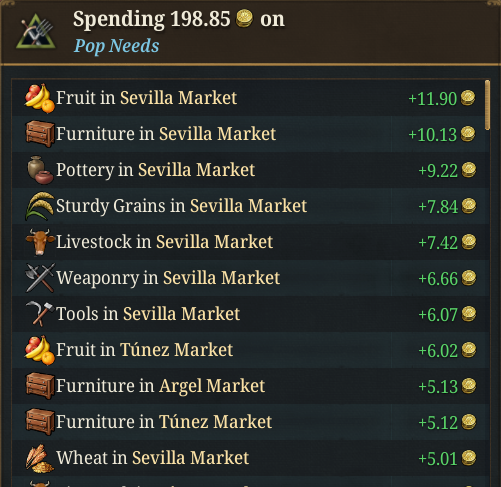
Estates also have monthly expenses, related to the needs of their Pops. Each Pop will try to consume a certain amount of goods each month, assuming it’s available in the market. This differs by Class (both the amount and the type of goods), religion (Muslims don’t consume Liquor), culture and Estate Income.
Hovering over the Expenses line in the Estate budget, we can see where my Nobility (or Ricahombria) is spending their money:
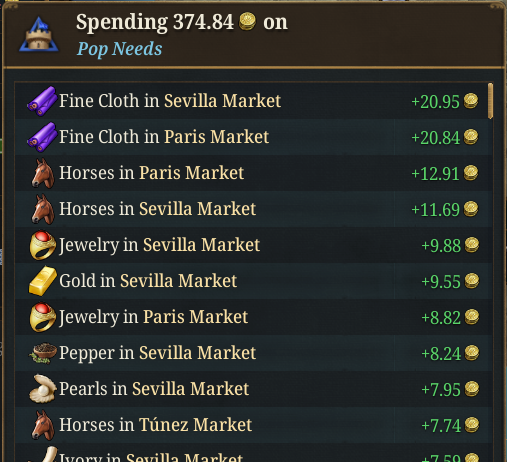
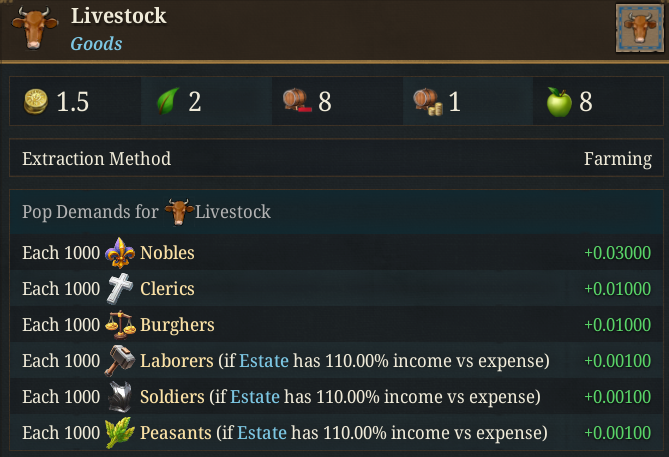
These needs are massively different from Estate to Estate:
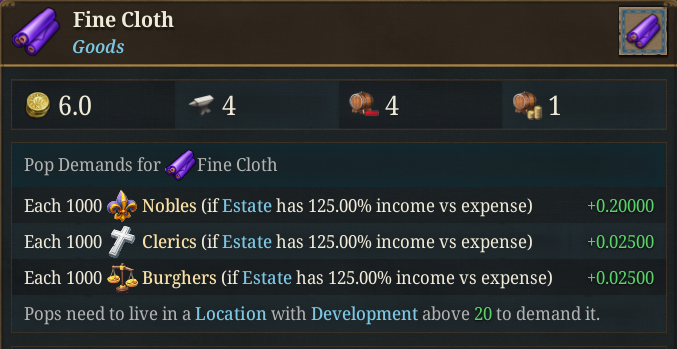
Demands are also dynamic based on overall Estate Income – a number of Pop Demands only kick in when the Estate has 10% or 25% “profit” each month:
Estate Constructions
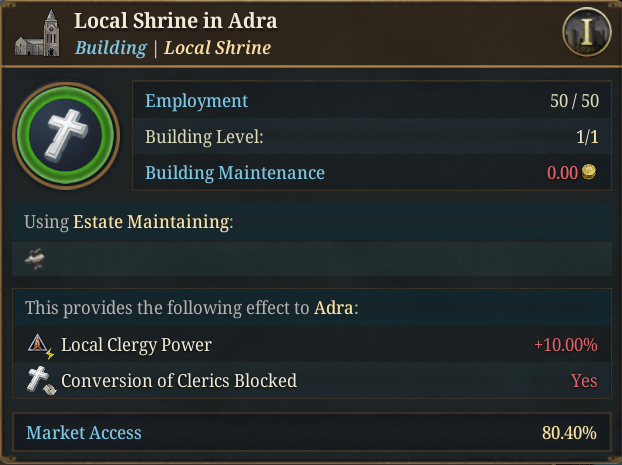
Estates who build up a buffer of gold can use it on buildings. What buildings it chooses depends on the Estate themselves (Nobles prefer military buildings, etc) as well as their Satisfaction. Put simply, happy Estates will build useful things and unhappy Estates unhelpful ones. Each Estate has access to special buildings that only help them:
But an Estate with high Satisfaction will build fewer of these and more Universities, Roads (Burghers need a special privilege to build roads and you should always give it to them), and Production Buildings.
The production buildings can be a double-edged sword – they are free to you as the Crown but they may be different from what you would choose to build, having unwanted effects on market pricing. Generally though the Estates are decent at placing economic buildings.
Some Estate buildings both help your nation and give bonuses to the Estates:
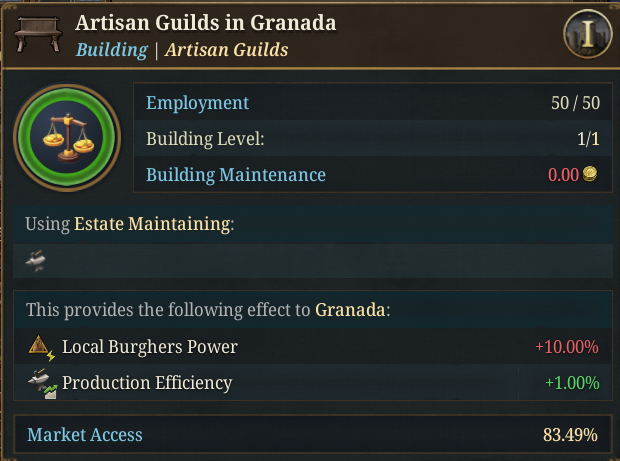
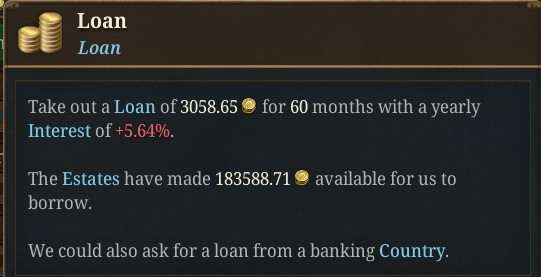
Not all Estate money goes into buildings – some is put aside into a pool of money that you as the player can use for loans.
A Dev Diary did state that Estates over 80% Satisfaction build only useful buildings, but this seems anecdotally to not be true.
How Estates Lose Money: An Example
Not all Estates make a profit, and Estates can end up destitute if not managed well. To illustrate this, let’s look at the booming, cosmopolitan town of Bani Walid:
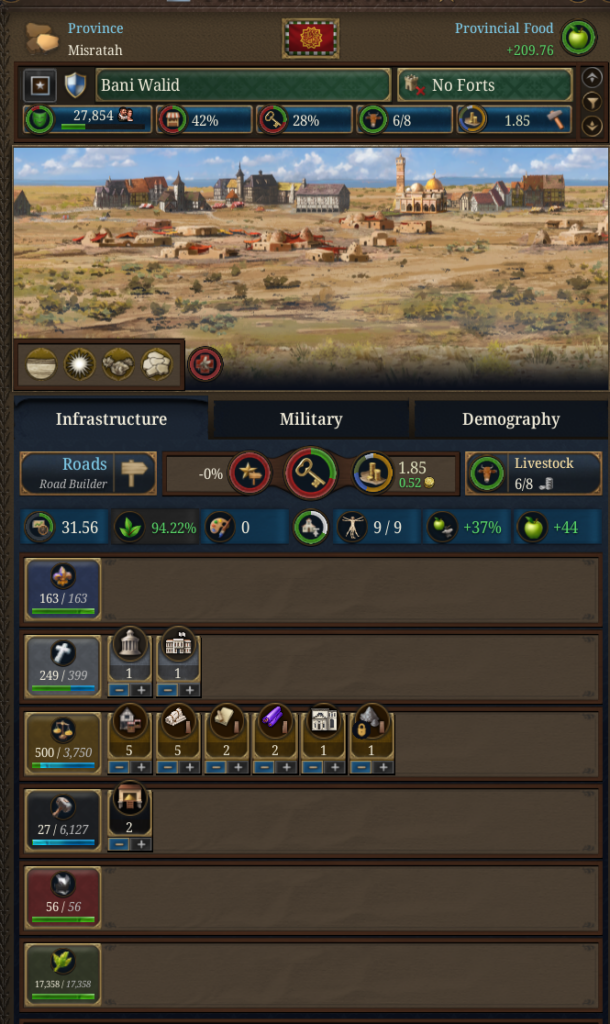
Bani Walid has 3,750 Burghers, 42% Market Access (which is pretty bad), and 28.85% Control. It has 10 production buildings, of which 1 is closed, as well as a Library and 5 Marketplaces. Note that the benefit of the Marketplaces is counted at a national level, not in the Location itself.
There are some Laborer and Clergy buildings but let’s focus on the Burghers and see how much money they’re making from this economic powerhouse:
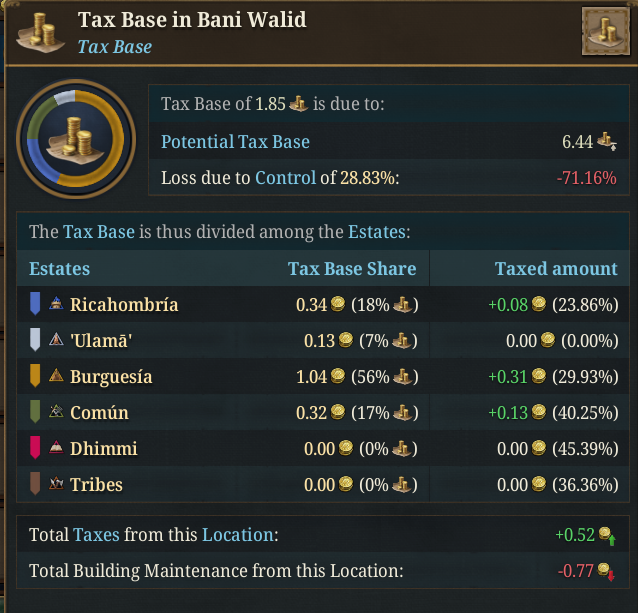
After taxation, the Burgers are earning 0.73 gold a month from Bani Walid, and they’re doing the best of all the Estates. I also note that Building Maintenance is higher than my tax take but the 5 Trade Capacity from the Marketplaces should more than cancel that out.
How about expenses? The location has 3,750 Burghers split into two Pop groups:
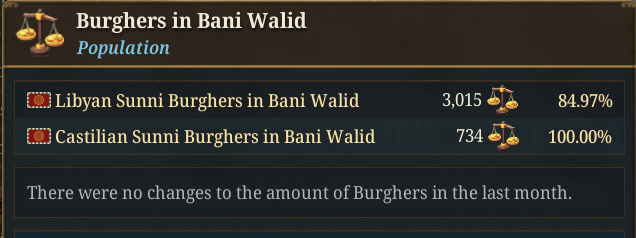
If we look at their demands, we can see what they’re purchasing from the Tunis market:
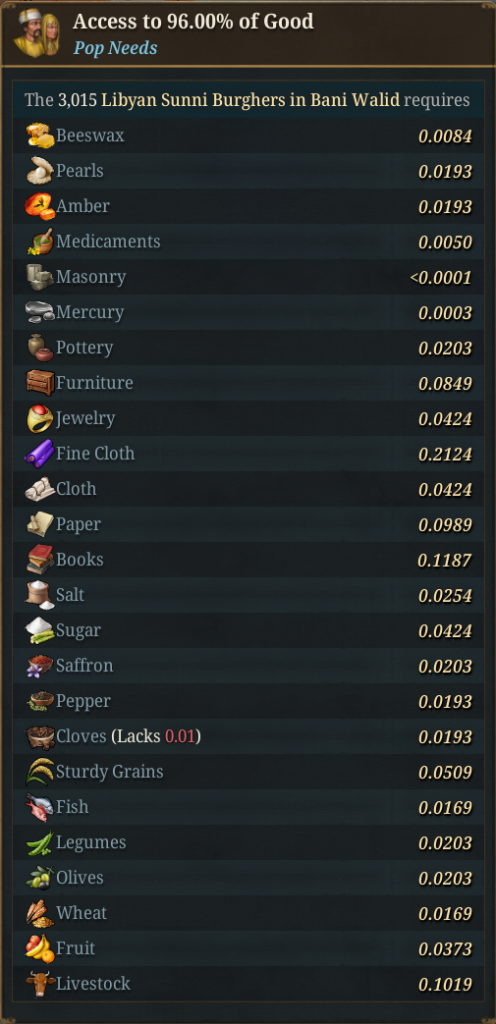
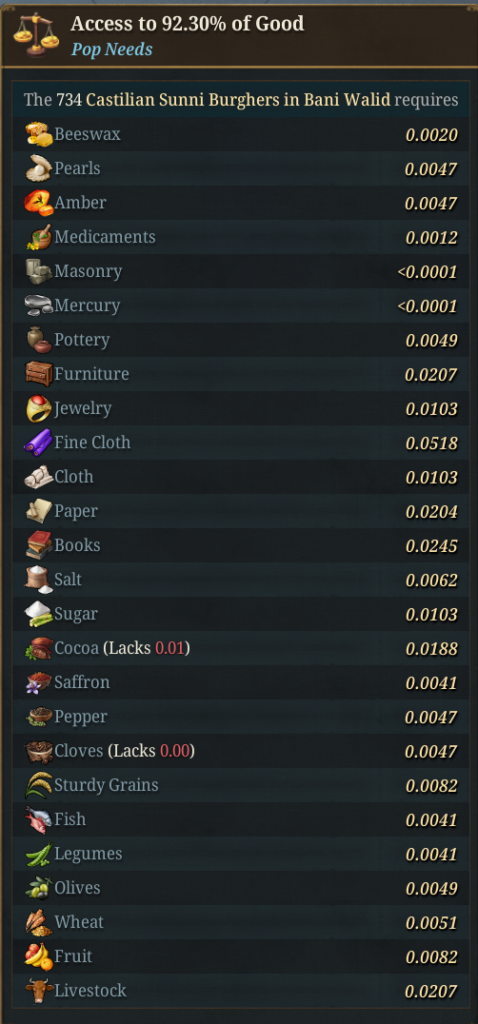
And all of this comes at a cost of:
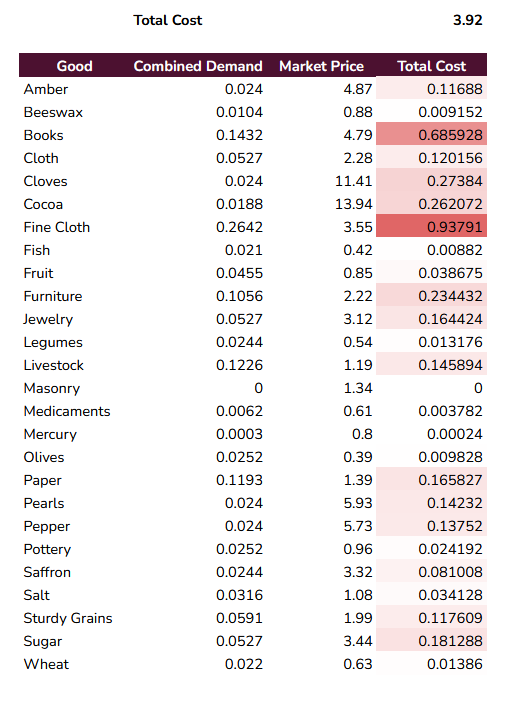
So, from an income of 0.73, the Burghers have to pay for 3.92 of goods, losing 3.19 gold a month in just this province.
If I compare this to Malaga, my Burghers there earn 48.08 after tax and the 19,350 Burghers will consume 20.22 of goods, delivering the Burghers a profit of 27.86 gold a month.
Malaga is in a different market, and the Burghers are largely a different religion, so the demand will actually be different. But I do spreadsheets in my day job and so refuse to do another one here.
The Strategy Of It All
So, should I de-urbanise Bani Walid, or at least close all of the Burgher buildings? That depends – if my sole objective was to make my Burghers wealthy, absolutely I should, but that’s not why I’m playing. This town is also giving me:
- 5 Trade Capacity, which is making 8.15 in Trade Profit, of which I get 2.93 and the Burghers 2.03 (so really they’re only losing about 1.16)
- 45% Average Literacy, compared to 19% in the surrounding rural areas, contributing in a small way to my Research Speed
- 25 Nobles and 50 Clerics, who also consume goods and help drive local prices up (but probably also make those Estates less profitable)
- Some extra Development thanks to the high literacy
- Higher-quality (and fewer) levies from the Burghers, Nobles and Clergy, though I’ve stopped using levies at this point in the game
- 5% Max Control, making the RGO and buildings that much more valuable, and
- The demand of those 3,750 Burghers, helping to make every single other RGO and building in the Tunis market profitable.
What I can do instead is either build more profitable buildings and less low-profit ones, or try to increase Control. Control really is the solution to everything in EU5’s economics. If Bani Walid had 61% Control, the Burghers would be breaking even (and I would be making more money from tax).
As it happens the Burghers in my nation overall are doing just fine as is:
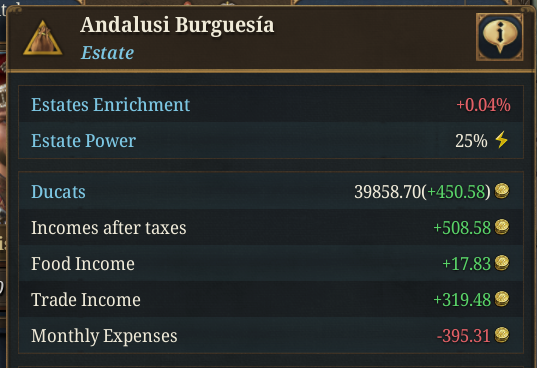
Where I might start to consider closing down urban locations is if the Burghers were losing money, or were below the 110% and 125% thresholds to generate extra demand – as that demand is key to keeping my economy up and running.
You may also want to keep certain Estates poor – in Monarchy runs it’s not uncommon to have a difficult relationship with your Nobility:
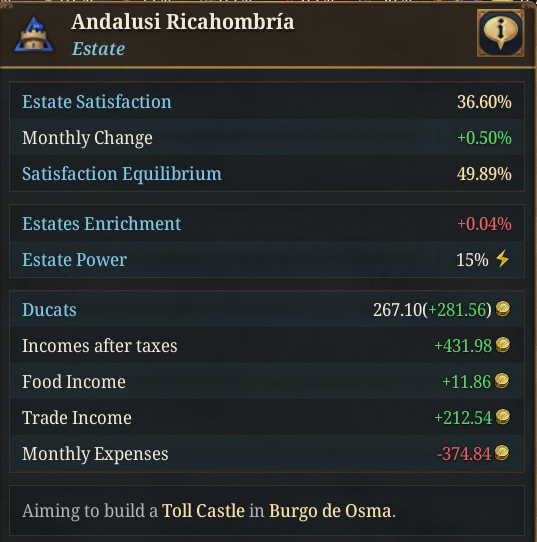
Minimising the income and power of the Nobility would mean building relatively few towns (as each town gets a flat number of Nobles) and stacking them high with Clergy and Burghers, so that there are fewer Nobles compared to the other Estates – and thus a smaller cut of the profits. Generally though your Clergy, Burghers and Nobles will prosper or fail together. You can also build more or less of certain buildings that help Estate power.
The TL;DR
The overall “recipe” for helpful Estates is:
- Keep your Estates happy! It’s generally not too difficult to stack Satisfaction to 80+ so long as you’re willing to sit on 35-45 Crown Power.
- Build up most of your economic capacity in high-Control areas (you should be doing this anyway), and in the really big economic centres, pay attention to the local profit split and the buildings that influence it – in my current run, 30% of Nobles income is from five locations.
- If annexing or integrating low-Control land, look at the local populations and consider closing buildings (also good economic advice), or even de-urbanising depending on RGOs.
- If an Estate is just below the 110% or 125% threshold, consider dropping taxes for a little while to juice demand – you can raise them again once the additional demand has pushed incomes up.
- Give the Burghers the privilege that lets them build roads.
- Work to reduce the prices of pop demands. In particular, Fine Cloth, Horses, Books and Wheat (culturally dependent) tend to make up a large chunk of expenses. Look at where Estates are spending their money and consider building less-profitable buildings to get those prices down.
Longum regnum tibi!
1 thought on “Deep Dive: Estate Finances”